
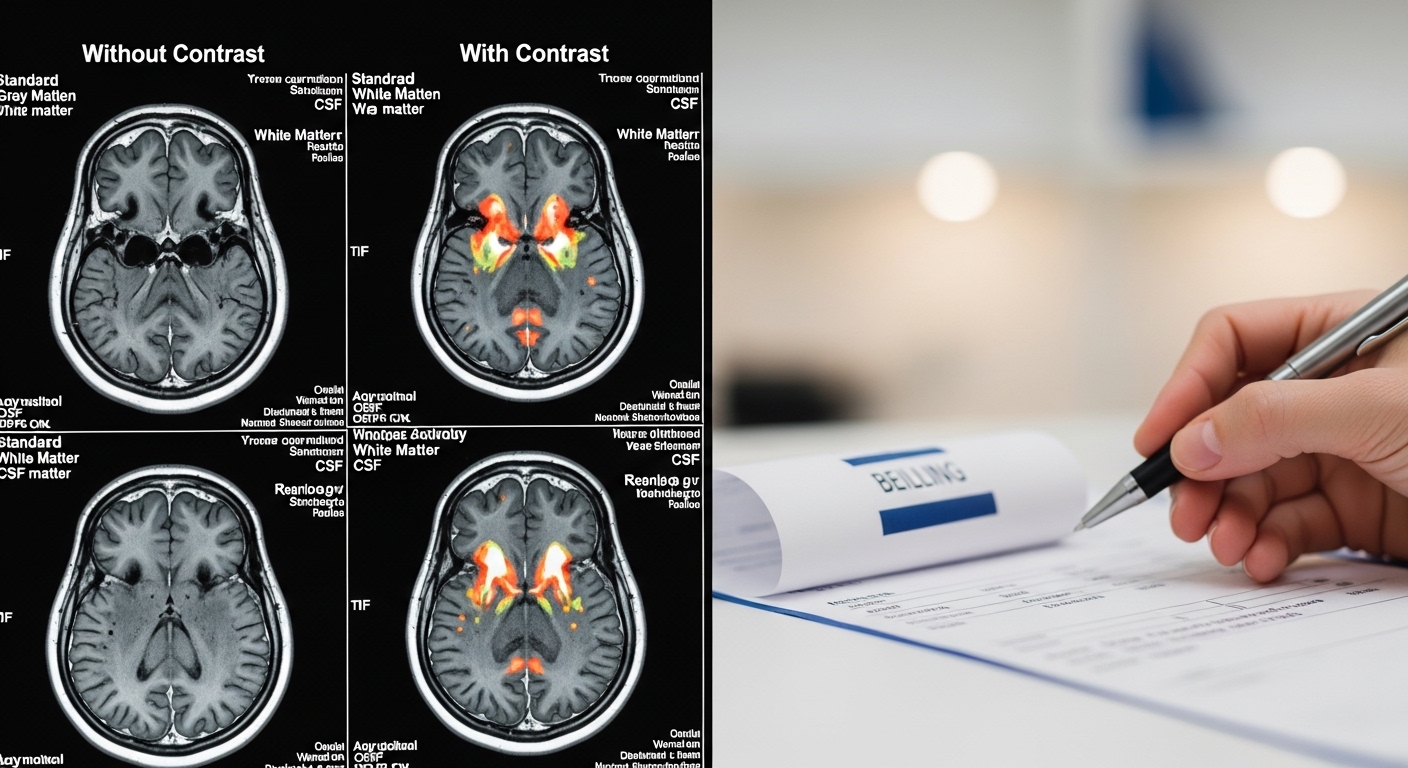
What Is an MRI of the Brain?
An MRI of the brain is an imaging study used to evaluate the brain and brain stem. Providers commonly order it when they need a closer look at neurological structures and possible abnormalities. Depending on the clinical concern, the study may be performed without contrast, with contrast, or in both phases.From a billing perspective, this matters because the claim must reflect the exam that was actually performed, not just the shorthand wording used during scheduling. CMS coverage guidance for head and neck imaging also recognizes that MRI studies may be ordered in different contrast phases depending on the clinical need, and that contrast is not automatically appropriate in every case.Why Correct Brain MRI Coding Matters
The correct code selection affects more than reimbursement. It also affects claim acceptance, audit readiness, and how quickly a practice gets paid.When a biller uses the wrong contrast status, the payer may see a mismatch between the order, report, or authorization and reject the claim. Even when the claim is not fully denied, it may be sent for review, delayed, or paid incorrectly. In high-volume imaging environments, these small errors create major revenue leakage over time.That is why a page like this matters for practices and billing teams. At Right On Time Billing Services, content like this should not only target search traffic, but also support the real operational work behind cleaner claims.CPT Code for MRI Brain: The Core Code Set
The easiest way to understand brain MRI coding is to separate it by contrast status.Brain MRI Code Comparison
| Exam type | Common search phrase | CPT code |
| Brain MRI without contrast | cpt code for mri brain without contrast | 70551 |
| Brain MRI with contrast | cpt code for mri of the brain with contrast | 70552 |
| Brain MRI with and without contrast | cpt code for mri brain with and without contrast | 70553 |
CPT Code for MRI Brain Without Contrast
Many billers first encounter this topic through searches like cpt code for mri brain without contrast, cpt code for mri of brain without contrast, or cpt code for mri of brain w/o contrast. These searches point to the non-contrast brain MRI service, which is commonly associated with 70551 in coding references.This code applies when the exam is completed without contrast material. The important point is that the final documentation has to support that no contrast was administered. If the report, contrast log, or final imaging record shows contrast use, the biller should not default to the non-contrast code simply because the original order was worded loosely.That is where many denials start: the order says one thing, the report reflects something else, and the claim follows the wrong document.CPT Code for MRI of the Brain With Contrast
Cpt code for mri of the brain with contrast is commonly tied to 70552.This code is used when the study is performed with contrast. Billing teams should review whether the documentation clearly supports contrast administration and whether the payer required prior authorization based on the final performed service.This step matters because “with contrast” is not interchangeable with “with and without contrast.” If both phases are performed, the claim logic changes.CPT Code for MRI Brain With and Without Contrast
Now to the main topic: the cpt code for mri brain with and without contrast.For standard brain MRI coding, the code most closely aligned with this service is 70553. CMS’s manual explicitly references 70553 as the brain MRI service performed first without contrast and then with contrast and additional sequences.This is the code billing teams usually need when:- the exam began with non-contrast imaging,
- contrast material was then administered,
- and additional post-contrast sequences were completed.
MRI Brain With Contrast vs Without Contrast vs With and Without Contrast
To make this simpler, think of the coding decision as a documentation match exercise.Practical Comparison Table
| Scenario | What happened clinically | Billing takeaway |
| Without contrast | MRI completed with no contrast administered | Review for 70551 support |
| With contrast | MRI completed using contrast only | Review for 70552 support |
| With and without contrast | MRI completed in non-contrast phase and then contrast phase | Review for 70553 support |
Documentation Requirements Before You Bill
Accurate coding starts with accurate records. For an MRI brain claim, the billing team should confirm several core elements before submission.First, review the physician order. Then review the radiology report. After that, confirm whether contrast was actually administered. If there is any discrepancy between the order and the final report, the performed service should be clarified before the claim is released.The most useful documentation elements usually include the order, the clinical indication, the final report, contrast status, and any payer-specific authorization details. CMS billing and coverage materials emphasize the importance of matching medical necessity and the documented service to the billed procedure.A Simple Review Sequence
| Step | What to verify |
| 1 | Was the exam brain only, or did it include another region? |
| 2 | Was contrast actually used? |
| 3 | Does the radiology report match the order? |
| 4 | Does the authorization match the performed service? |
| 5 | Is the CPT code aligned with the final documentation? |
Common Coding and Billing Mistakes
A blog about the cpt code for mri brain with and without contrast would be incomplete without addressing where practices lose money.One of the most common mistakes is relying on the order alone. A scheduler may enter “MRI brain w/o,” but the radiologist may complete a contrast-enhanced study after clinical review. If the biller never checks the final report, the claim may go out with the wrong code.Another common error is treating “with and without contrast” as two separately billable MRI brain procedures from the same session. CMS’s Medicare Claims Processing Manual specifically warns against this type of duplicate payment logic when 70553 is already billed.A third problem is abbreviation confusion. Staff may read “w/wo” too quickly, misread “w/o,” or rely on copied forwarding notes. In imaging billing, one slash can change the entire code selection.How Billing Teams Should Review MRI Brain Claims
The best review process is not complicated, but it needs to be consistent.Start with the final radiology report, not the front-desk note. Then compare the report against the order and the authorization. Confirm the contrast status. Validate that the diagnosis supports the service. Finally, apply payer edits before claim submission.In most organizations, the cleanest claims come from a workflow where coders and billers treat imaging documentation as a sequence, not as isolated documents. That approach matters more for advanced imaging than many teams realize.Where SEO and Operational Accuracy Meet
For rotbilling.com, this topic is strong because it serves two purposes at once.It targets a high-intent keyword cluster around MRI coding, and it also shows healthcare providers that your team understands real billing operations. A practice manager reading about the cpt code for mri brain with and without contrast is often not just looking for a definition. They are looking for clarity, denial prevention, and trust.That is why educational pages in the medical billing niche perform best when they answer the coding question, explain the billing risk, and then connect the topic to workflow improvement.How Right On Time Billing Services Can Help
Imaging claims are often denied for reasons that look small on the surface but are expensive in practice. Contrast mismatches, report-order conflicts, missing authorization alignment, and claim coding errors all create avoidable delays.Right On Time Billing Services can position itself here as a knowledgeable billing partner that helps practices tighten documentation review, improve coding accuracy, and reduce preventable denials tied to radiology services. That positioning works because it is relevant to the reader’s real problem.Final Thoughts
The cpt code for mri brain with and without contrast is more than just a search phrase. It sits at the center of a common radiology billing workflow where precision matters.For most standard coding references, the brain MRI code set breaks down as 70551 for without contrast, 70552 for with contrast, and 70553 for with and without contrast. The most important rule is simple: bill the service that was actually performed and documented, not the version someone assumed earlier in the process.When billing teams get that right, they reduce denials, protect reimbursement, and build stronger operational trust with providers.Frequently Asked Questions (FAQs)
Get clear and practical insights into the CPT code for MRI brain with and without contrast, including how to correctly code different MRI brain studies, avoid common billing errors, and ensure accurate claim submission. Learn how proper documentation, coding accuracy, and structured workflows can reduce denials, speed up reimbursements, and improve your practice’s revenue cycle performance.
The commonly referenced code for a brain MRI performed both without contrast and then with contrast is 70553. CMS’s manual also discusses 70553 in the context of the combined service.
The commonly referenced non-contrast brain MRI code is 70551.
The commonly referenced brain MRI with contrast code is 70552.
It generally means the study was performed in two phases: first without contrast, then with contrast. In coding discussions, that usually aligns with the combined “with and without contrast” brain MRI service.
CMS’s Medicare Claims Processing Manual says that when 70553 is billed, Medicare does not make separate payment for an additional non-contrast brain MRI code from that same session.
Common reasons include wrong contrast status, mismatched documentation, medical necessity issues, or authorization problems. CMS billing and coverage materials emphasize matching the service billed to the documented study and coverage requirements.