
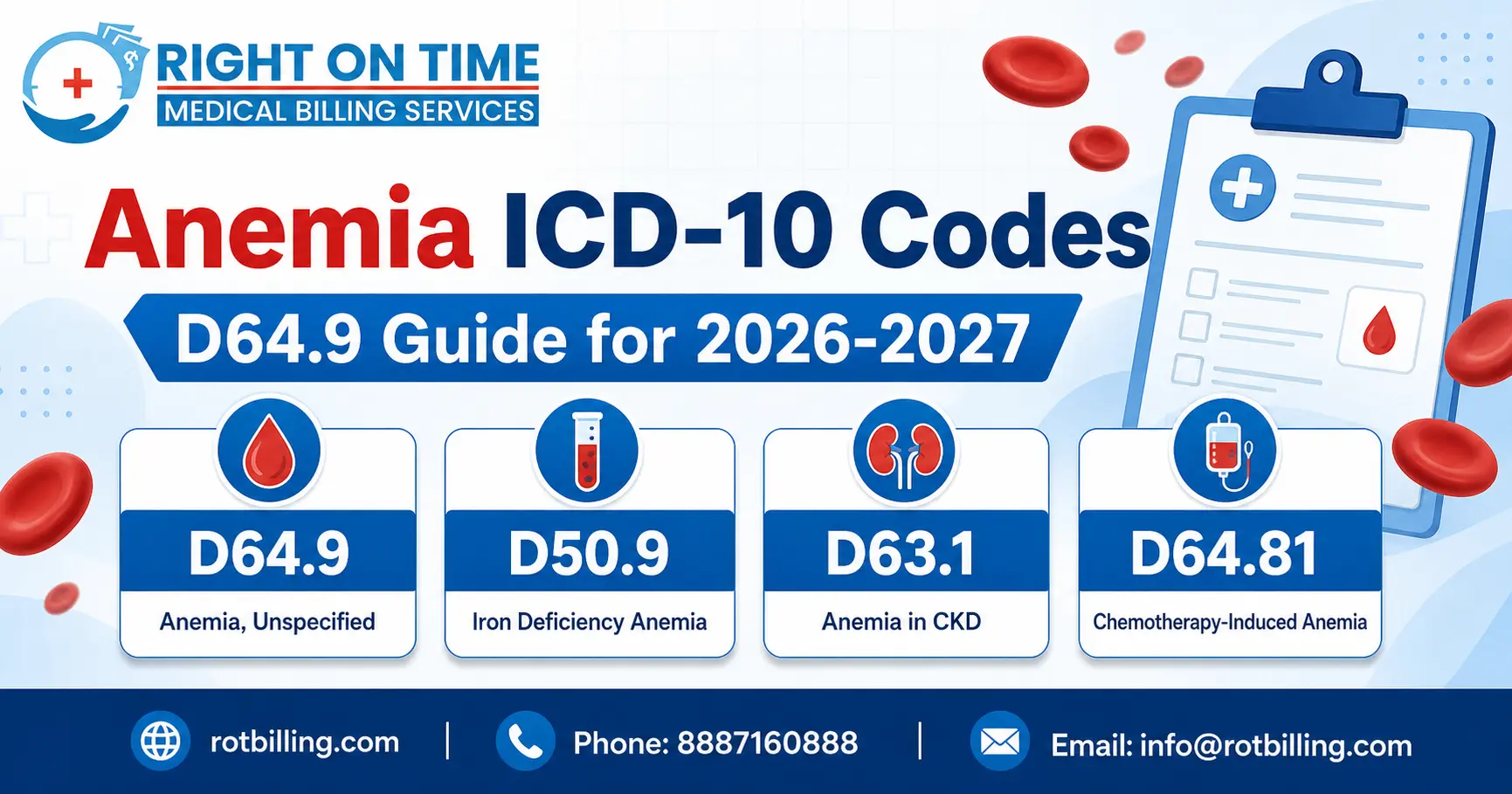
Anemia may look like a simple diagnosis, but ICD-10-CM classifies it by cause, type, and clinical setting. Choosing D64.9 when the record supports a more specific code can reduce claim accuracy. Guessing from laboratory results can also create compliance problems. This guide explains the major anemia ICD-10 codes, sequencing rules, documentation requirements, and common coding scenarios.
TL;DR
The ICD-10-CM code for unspecified anemia is D64.9. Use it when a provider documents anemia without identifying its type or cause. Review D50.9 for iron deficiency anemia, D63.1 for anemia in chronic kidney disease, D63.0 for anemia in neoplastic disease, and D64.81 for chemotherapy-induced anemia. Always follow provider documentation, verify the Alphabetic Index and Tabular List, and use the edition that applies to the date of service.
What Is the ICD-10 Code for Anemia?
The ICD-10-CM code for unspecified anemia is D64.9. The code applies when the provider documents anemia but does not identify a specific type, cause, or relationship to another condition.
D64.9 belongs to category D64, Other anemias, in Chapter 3 of the U.S. ICD-10-CM classification. It is a billable and specific diagnosis code, so it does not require additional characters.
However, ICD-10-CM provides many cause-specific anemia codes. The official CDC ICD-10-CM Browser lets users search the Index, review Tabular List instructions, and select the correct fiscal-year edition.
Common Anemia ICD-10 Codes
The following table covers frequently reported anemia codes. The provider’s documentation and current Tabular List determine the final selection.
| Diagnosis | Code | When to review it |
|---|---|---|
| Anemia, unspecified | D64.9 | The provider does not identify a type or cause |
| Other specified anemias | D64.89 | The provider identifies a type without a dedicated code |
| Iron deficiency anemia, unspecified | D50.9 | The provider documents iron deficiency anemia without more detail |
| Iron deficiency anemia due to chronic blood loss | D50.0 | Chronic blood loss causes the iron deficiency |
| Sideropenic dysphagia | D50.1 | The provider documents Plummer-Vinson syndrome |
| Other iron deficiency anemias | D50.8 | The provider specifies another form of iron deficiency anemia |
| Pernicious anemia | D51.0 | Intrinsic factor deficiency causes the B12 deficiency anemia |
| Vitamin B12 deficiency anemia, unspecified | D51.9 | The provider does not identify the specific B12-related cause |
| Folate deficiency anemia, unspecified | D52.9 | The provider documents folate deficiency anemia |
| Nutritional anemia, unspecified | D53.9 | The provider documents nutritional anemia without more detail |
| Acute posthemorrhagic anemia | D62 | Acute blood loss causes the anemia |
| Anemia in neoplastic disease | D63.0 | A neoplasm causes the anemia |
| Anemia in chronic kidney disease | D63.1 | CKD causes the anemia |
| Anemia in another chronic disease | D63.8 | Another classified chronic disease causes the anemia |
| Chemotherapy-induced anemia | D64.81 | Antineoplastic chemotherapy causes the anemia |
Do not choose a code from the table alone. Locate the diagnosis in the Alphabetic Index, then verify the code and all instructions in the Tabular List.
When Should You Use D64.9?
Use D64.9 when the provider documents only “anemia,” “unspecified anemia,” or “anemia NOS.” NOS means “not otherwise specified.”
D64.9 may also fit chronic, normocytic, or normochromic anemia when the provider does not identify an underlying cause. These descriptions explain duration or red-cell appearance, but they do not always establish etiology.
Avoid D64.9 when the documentation identifies:
- Iron, vitamin B12, folate, or another nutritional deficiency
- Acute or chronic blood loss
- Chronic kidney disease
- Neoplastic disease
- Antineoplastic chemotherapy
- Hemolysis or bone marrow failure
- A drug or toxic substance
- Pregnancy-related anemia
D64.9 is not inherently incorrect. It becomes less appropriate when the record supports a more specific code.
D64.89 also differs from D64.9. Use D64.89 when the provider specifies the anemia type but ICD-10-CM does not provide a more dedicated code. Use D64.9 when the provider does not specify the type.
How Do You Select the Correct Anemia Code?
Use this process before assigning an anemia code:
- Review the provider’s exact diagnostic statement.
- Identify the documented type, cause, acuity, or associated condition.
- Locate the diagnosis in the Alphabetic Index.
- Verify the code in the Tabular List.
- Review code-first, additional-code, Excludes1, and Excludes2 instructions.
- Apply the sequence required by the encounter.
- Query the provider when the documentation remains incomplete or conflicting.
A documentation checklist can make this review faster:
- Does the provider identify the anemia type?
- Does the assessment state the cause?
- Is blood loss acute or chronic?
- Does the provider link anemia to CKD, cancer, or another disease?
- Did chemotherapy, radiation, medication, or a toxin cause it?
- Does the record identify pregnancy trimester?
- Does the provider document the CKD stage?
- Do the findings support a compliant clarification query?
Practices that need help with code selection and documentation review can explore Right On Time Medical Billing’s medical coding services.
What Are the Sequencing Rules for Anemia?
Some anemia codes represent manifestations of another condition. In those cases, the underlying disease usually appears first.
| Scenario | Code first | Following code |
| Anemia in CKD | Appropriate N18.- CKD stage | D63.1 |
| Anemia in neoplastic disease | Neoplasm code | D63.0 |
| Anemia in another chronic disease | Underlying disease | D63.8 |
| Encounter focused on chemotherapy-induced anemia | D64.81 | Neoplasm code and applicable T45.1X5- adverse-effect code |
| Anemia complicating pregnancy | Appropriate O99.01- code | Specific anemia code when required |
The reason for the encounter can change the order. For example, sequencing for anemia caused by a neoplasm differs from sequencing for anemia caused by chemotherapy.
Always verify the current Tabular List and official guidelines before finalizing a claim. Do not apply one sequence to every cancer or therapy-related encounter.
How Do You Code Common Anemia Scenarios?
Iron deficiency and blood-loss anemia
Use D50.9 when the provider documents iron deficiency anemia without identifying a more specific form or cause. Use D50.0 when chronic blood loss causes the iron deficiency anemia.
D62 covers acute posthemorrhagic anemia. A postoperative decrease in hemoglobin does not support D62 unless the provider documents acute blood-loss anemia.
Anemia in chronic kidney disease
Use D63.1 when the provider documents anemia in CKD. Code the underlying CKD first with the appropriate N18.- stage code.
For example, documented anemia in stage 4 CKD requires N18.4 followed by D63.1. Do not substitute D64.9 when the record supports D63.1.
Cancer-related and chemotherapy-induced anemia
D63.0 describes anemia caused by the neoplastic disease. D64.81 describes anemia caused by antineoplastic chemotherapy.
These codes identify different causes and may require different sequencing. Review the reason for the encounter, neoplasm code, and applicable adverse-effect code before submission.
Anemia complicating pregnancy
The trimester-specific codes include:
- O99.011 for the first trimester
- O99.012 for the second trimester
- O99.013 for the third trimester
- O99.019 for an unspecified trimester
Use an additional anemia code when the instructions and documentation require one. Verify trimester, anemia type, and sequencing before reporting the claim.
Severe, symptomatic, and morphology-based anemia
“Severe” and “symptomatic” describe clinical status, not the cause. If the provider documents no type beyond severe or symptomatic anemia, D64.9 may apply, but a query may produce greater specificity.
Macrocytic, microcytic, normocytic, and normochromic describe red-cell characteristics. Do not infer iron, B12, folate, or chronic-disease anemia from morphology alone.
Can You Assign Anemia From Laboratory Results?
No. A coder cannot diagnose anemia or determine its type from laboratory findings alone. The provider must document the diagnosis.
Hemoglobin, hematocrit, MCV, ferritin, serum iron, vitamin B12, folate, and reticulocyte results may support clinical evaluation or a provider query. However, they do not authorize a coder to create a diagnosis.
The FY 2026 Official ICD-10-CM Coding Guidelines state that code assignment relies on the provider’s diagnostic statement rather than the clinical criteria used to establish that diagnosis.
Regular medical coding audits can identify vague documentation, D64.9 overuse, and recurring code-selection problems.
Anemia Coding Examples
Unspecified anemia
The provider documents anemia and orders further testing without identifying a cause.
Code to review: D64.9
Iron deficiency anemia
The provider documents iron deficiency anemia without identifying its cause.
Code to review: D50.9
Anemia in stage 4 CKD
The provider documents anemia caused by stage 4 CKD.
Codes to review: N18.4 followed by D63.1
Chemotherapy-induced anemia
The provider documents anemia caused by antineoplastic chemotherapy.
Code to review: D64.81, followed by the additional codes required by the encounter and current instructions.
These simplified examples do not replace review of the complete record or payer requirements.
Is D64.9 Current for 2026 and 2027?
D64.9 remains valid for unspecified anemia. Coders must use the edition that applies to the date of service.
| Edition | Applicable dates |
| FY 2026 | Through September 30, 2026 |
| FY 2027 | October 1, 2026 through September 30, 2027 |
The CDC ICD-10-CM release files provide the official code tables, Index, addenda, guidelines, and effective dates.
What Does D64.9 Mean for a Patient?
D64.9 means that a healthcare provider documented anemia without identifying its exact type or cause. It does not automatically mean iron deficiency.
Patients should not begin iron, vitamin B12, folate, or another treatment based only on the code. A clinician may need to investigate nutritional deficiency, blood loss, chronic disease, medication effects, or another cause.
Key Takeaway
D64.9 answers the general “anemia ICD 10” query, but it does not replace cause-specific codes. Follow provider documentation, verify the Alphabetic Index and Tabular List, apply current sequencing instructions, and use the correct fiscal-year edition.
Right On Time Medical Billing provides medical billing and coding support for practices that want to improve claim accuracy, reduce administrative work, and strengthen revenue-cycle performance.
Frequently Asked Questions
Is D64.9 billable?
Yes. D64.9 is a billable and specific ICD-10-CM diagnosis code. Confirm that the selected edition applies to the date of service.
What is the difference between D64.9 and D50.9?
D64.9 identifies anemia without a documented type or cause. D50.9 identifies documented iron deficiency anemia without a more specific form or cause.
What is the code for pernicious anemia?
D51.0 identifies vitamin B12 deficiency anemia due to intrinsic factor deficiency, commonly called pernicious anemia.
What is the code for severe anemia?
ICD-10-CM does not provide one universal severe-anemia code. Select the documented type or cause. D64.9 may apply when no greater specificity exists.
Does low hemoglobin support D64.9?
A low hemoglobin result alone does not support an anemia diagnosis code. The provider must document anemia or interpret the finding.
Does D64.9 always cause a denial?
No. Payers assess the code with documentation, medical necessity, the billed service, coverage rules, and other claim information. A structured denial management process can identify repeated coding-related rejections.