
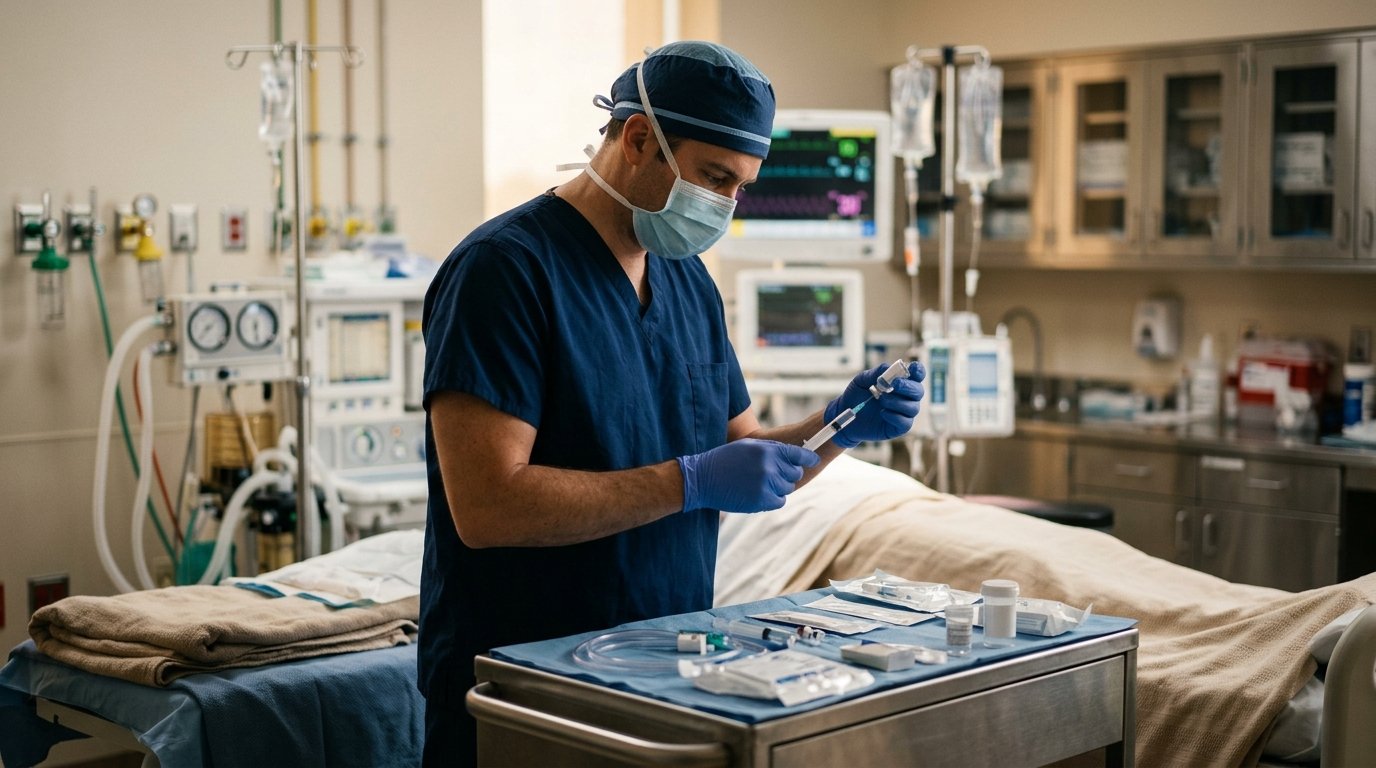
CPT Code 57410 for Pelvic Examination Under Anesthesia
CPT 57410 describes a pelvic examination under anesthesia, other than local. It plays a central role in gynecological coding. Consequently, most searches for the examination under anesthesia CPT code lead to this code first. Still, its use carries strict limits.CPT 57410 Code Description and Clinical Application
A pelvic examination under anesthesia lets the gynecologist assess the uterus, adnexa, and pelvic support. Muscle relaxation under anesthesia reveals findings that an awake exam can miss. For example, the provider can better judge the size, mobility, and tenderness of pelvic organs.Providers perform this examination in several circumstances. Some patients cannot tolerate an awake exam because of pain or trauma. Others need a precise pelvic assessment before a planned intervention. In addition, a suspected mass or abnormality may require a deeper evaluation.Before billing, coders must identify the nature of the service. Was the examination diagnostic and standalone? Was it part of a larger surgical procedure? Or was it a distinct, separately documented service? Each answer changes the coding outcome.Finally, always confirm the current CPT descriptor in an authoritative reference. The American Medical Association maintains the CPT code set and updates it every year. A memorized descriptor may no longer match the current edition.Clinical Situations Involving Pelvic Examination Under Anesthesia
Several scenarios lead to a pelvic EUA in gynecology:- Awake examination is not feasible. Severe pelvic pain, vaginismus, or developmental conditions can prevent an adequate office exam.
- Assessment before a planned intervention. The surgeon confirms pelvic anatomy before a hysterectomy or myomectomy.
- Suspected gynecological abnormality. The provider evaluates a suspected mass, fistula, or structural defect.
- Examination with another procedure. The EUA accompanies a dilation and curettage, hysteroscopy, or colposcopy.
When CPT 57410 May Not Be Separately Reportable
Coders should ask four questions before reporting CPT 57410 on its own:- Does the larger surgical service routinely include the examination?
- Is the examination an integral part of the primary procedure?
- Does the documentation establish a distinct, medically necessary service?
- Do National Correct Coding Initiative (NCCI) edits or payer policies restrict separate reporting?
Examination Under Anesthesia CPT Codes by Anatomical Area and Specialty
Coders must identify the precise anatomical area examined. The phrase “examination under anesthesia” appears in operative reports across many specialties. However, each specialty reports the service with a different examination under anesthesia CPT code. One code never fits every encounter.Pelvic Examination Under Anesthesia in Gynecology
In gynecology, the pelvic examination supports the broader gynecological assessment. The provider examines the uterus, cervix, ovaries, and pelvic floor under anesthesia. Then the findings guide the surgical plan or the diagnosis.The relationship between the EUA and other gynecological procedures drives code selection. A standalone diagnostic EUA may support CPT 57410. Yet an EUA that precedes surgery usually bundles into the surgical code. Similarly, an EUA performed with a colposcopy procedure follows the rules for that procedure.Therefore, coders should base every decision on the documented service and current CPT guidance. When surgery accompanies the examination, apply the bundling considerations from the previous section.Examination Under Anesthesia in Colorectal and Anorectal Care
Colorectal surgeons examine the anorectal region under anesthesia to evaluate fissures, fistulas, abscesses, and masses. Here, the coding question centers on scope. Did the surgeon only examine the area, or did they treat something?A diagnostic anorectal examination differs from a therapeutic intervention. For instance, a surgeon may examine the anus and then drain an abscess. Alternatively, the surgeon may perform a biopsy of a suspicious lesion. Each added service may carry its own code.Coders should review the CPT code family that matches the exact service. The anorectal section of the surgery chapter contains the relevant codes. Our gastroenterology billing guide covers nearby endoscopic services and their rules.Examination Under Anesthesia in Otolaryngology
Otolaryngologists examine the ears, nose, and throat under general anesthesia. Children and patients with severe anxiety often cannot tolerate an adequate awake examination. In those cases, general anesthesia allows a complete ENT assessment.CPT 92502 describes an otolaryngologic examination under general anesthesia. It may apply when the provider performs an examination-only service. However, coders must separate the examination from any additional diagnostic or surgical procedures. For example, a tympanostomy tube placement carries its own code and usually includes the examination.Thus, the examination under anesthesia CPT code for ENT depends on what the provider actually did. Review the operative note for any procedure performed beyond the examination.Examination Under Anesthesia in Other Specialties
Urology also uses examination under anesthesia for bladder, urethral, and genital evaluations. Often, the urologist pairs the exam with a diagnostic cystoscopy. In that case, the cystoscopy CPT code 52000 usually represents the service, not an examination code.Other specialties perform EUAs as well. Orthopedists assess joint stability under anesthesia. Ophthalmologists examine pediatric patients under anesthesia. In each case, review the code descriptor and guidelines for the applicable specialty.Above all, avoid selecting a code based solely on the phrase “examination under anesthesia.” Instead, read the full operative report and match the documented service to the correct code family.Specialty-Based Coding Considerations| Specialty or service area | Coding consideration | Documentation focus |
| Gynecology | Evaluate CPT 57410 applicability | Pelvic examination findings and associated procedures |
| Colorectal surgery | Identify the specific anorectal examination or intervention | Anatomical site, examination findings, and treatment performed |
| Otolaryngology | Evaluate CPT 92502 applicability | ENT examination under general anesthesia |
| Urology | Identify the exact examination or procedure performed | Urinary tract structures and procedural details |
| Other specialties | Review the relevant CPT code family | Clinical purpose, anatomical site, and complete operative report |
Factors That Determine the Correct Examination Under Anesthesia CPT Code
Four principal factors influence code selection. Coders who check each factor make fewer errors. Furthermore, they build claims that survive payer review.Anatomical Site and Scope of the Examination
The anatomical region examined determines the code family. A pelvic examination belongs in the female genital system section. An anorectal examination belongs in the digestive system section. Meanwhile, an ENT examination belongs in the medicine section.Consequently, these three examinations should never carry the same code. Even when the clinical purpose looks identical, the CPT structure separates them by body system. Scope matters too, because a limited exam and a complete exam may differ.Diagnostic Examination Versus Therapeutic Procedure
Coders must distinguish four situations:- Examination without an additional intervention. The examination alone may be reportable.
- Examination followed by a biopsy. The biopsy code may apply, and the examination may bundle into it.
- Examination followed by treatment or removal of abnormal tissue. The therapeutic code represents the service.
- Examination performed as part of a larger surgical procedure. The surgical code includes the examination.
Type of Anesthesia and Provider Responsibilities
The type of anesthesia affects coding in two ways. First, CPT 57410 specifies anesthesia “other than local.” Second, CPT 92502 specifies general anesthesia. Therefore, the anesthesia technique must match the code descriptor.The surgeon’s procedure code also differs from the anesthesia professional’s anesthesia code. The surgeon reports the examination or surgical service. Meanwhile, the anesthesiologist or CRNA reports an anesthesia code from the 00100–01999 range. Each provider documents and bills their own service separately.CMS distinguishes anesthesia services from the surgical or diagnostic procedure itself. The Medicare Claims Processing Manual, Chapter 12, provides separate guidance for anesthesia billing. Coders should identify which provider performed and documented each service before coding.Medical Necessity and Patient-Specific Circumstances
The clinical record must explain why the examination was necessary. It must also explain why anesthesia was appropriate in the circumstances. Payers want to see a reason the awake examination failed or could not proceed.Strong documentation includes the relevant symptoms and clinical indications. It also includes the examination limitations, such as pain or inability to cooperate. Finally, it states the purpose of the procedure and the expected clinical benefit.Documentation Requirements for Examination Under Anesthesia Coding
Accurate documentation supports defensible code selection. It also reduces avoidable claim issues, such as records requests and medical necessity denials. In short, the operative report must tell the complete story.Essential Elements of the Operative Report
Every EUA operative report should contain these elements:- Preoperative diagnosis and postoperative diagnosis, when applicable
- Clinical indication for the examination
- Anatomical region examined
- Type of examination performed
- Findings and relevant observations
- Additional procedures performed during the same session
- Medical necessity for the service
- Provider authentication and other required operative details
Documenting Additional Procedures Performed During EUA
Coders must identify whether the physician performed services beyond the examination itself. The operative report should clearly describe each additional service:- Biopsy and specimen collection
- Endoscopic evaluation, when applicable
- Treatment of identified abnormalities
- Other diagnostic or therapeutic interventions
Handling Incomplete or Ambiguous Documentation
Sometimes the operative report does not clearly establish the service performed. In that case, follow a consistent process:- Review the complete medical record, including the procedure log and pathology.
- Compare the operative description with the proposed CPT code descriptor.
- Request clarification from the provider when necessary.
- Avoid assuming that an examination included a procedure that is not documented.
- Follow organizational policies for compliant coding queries.
Examination Under Anesthesia CPT Code Billing and Reimbursement Guidelines
Correct code assignment connects directly to claim preparation and reimbursement. A right code with wrong supporting data still fails. Therefore, billers must align every claim element with payer requirements.Procedure Coding Versus Anesthesia Coding
The two billing categories serve different purposes. The table below separates them.| Billing category | Primary purpose | Key consideration |
| Procedural CPT code | Represents the examination or surgical service | Must match the procedure actually performed |
| Anesthesia CPT code | Represents the anesthesia service provided by the anesthesia professional | Must reflect the applicable anesthesia code family and service |
| Diagnosis code | Represents the documented clinical condition or indication | Must be supported by the medical record |
| Modifiers, when applicable | Communicate circumstances relevant to the service | Use only when supported by coding rules and payer requirements |
Bundling and Unbundling Restrictions
NCCI procedure-to-procedure (PTP) edits prevent payment for services that should not be billed together. Many examination codes sit in column two of these edit pairs. In other words, the primary procedure includes them.Services integral to a primary procedure are never separately reportable. The pelvic EUA within a hysterectomy is the classic example. Likewise, an ENT examination within a tonsillectomy bundles into the surgical code.A distinct examination should not automatically be billed separately. Instead, confirm that the edit allows a modifier and that documentation supports a separate service. Then review current payer policies and CPT guidelines before you submit. CMS posts the NCCI PTP edit files each quarter.Modifier Usage and Payer-Specific Requirements
Modifiers communicate special circumstances, but they carry audit risk. Review the circumstances before assigning any modifier. Use a modifier only when its definition and reporting requirements are fully satisfied.Professional and facility claims may follow different payer rules. Therefore, confirm payer-specific requirements for each claim type. Never use a modifier as a workaround for services that are already bundled. Payers detect that pattern quickly, and recoupments follow.Medical Necessity, Claim Accuracy, and Reimbursement
The documented clinical indication, diagnosis, procedure code, and payer coverage criteria must align. When one element conflicts with another, the claim stalls. Unsupported code selection leads to rejections, denials, or requests for records.Incomplete documentation causes similar payment delays. Our medical denial management playbook explains how to appeal these denials step by step.Common Examination Under Anesthesia Coding Errors to Avoid
Certain mistakes appear again and again in audit findings. Billing and coding professionals should recognize each one.Applying CPT 57410 to Every Examination Under Anesthesia
CPT 57410 describes a pelvic examination only. It never applies to an ENT, anorectal, or urological examination. Coders who use it as a default examination under anesthesia CPT code create incorrect claims. Match the code to the anatomical region every time.Separately Billing a Bundled Examination
Reporting a pelvic EUA alongside a major or minor gynecological procedure violates NCCI guidance. The examination is included in those procedures. Separate billing creates an overpayment that payers can recoup later.Confusing the Procedure Code With the Anesthesia Code
The surgeon’s code and the anesthesia provider’s code represent different services. Mixing them results in incorrect claim categorization and inaccurate billing. Each provider type reports from a different section of the CPT code set.Reporting Additional Procedures Without Supporting Documentation
A separately reported procedure must appear in the operative report. The report must also show that the procedure meets the relevant coding requirements. Coders cannot infer a biopsy from a pathology report alone.Using Outdated CPT Descriptors or Coding Rules
Coding rules change constantly. Stay alert to these updates:- Annual CPT updates each January
- Changes to code descriptors and guidelines
- Updated NCCI edits each quarter
- Payer policy revisions throughout the year
Practical Examination Under Anesthesia Coding Scenarios
The following examples show how to approach coding decisions. They do not imply guaranteed code assignments without complete documentation.Scenario Involving Pelvic Examination Under Anesthesia
- Clinical situation: A gynecologist performs a pelvic examination under anesthesia.
- Coding focus: Evaluate whether CPT 57410 describes the documented service.
- Additional review: Determine whether the examination was integral to another procedure.
- Billing consideration: Check current bundling guidance before separate reporting.
Scenario Involving ENT Examination Under General Anesthesia
- Clinical situation: An ENT physician examines a patient under general anesthesia.
- Coding focus: Evaluate whether CPT 92502 applies to the documented examination.
- Additional review: Identify any separate diagnostic or therapeutic services.
- Billing consideration: Confirm that the code descriptor matches the complete service performed.
Scenario Involving Examination With a Therapeutic Intervention
- Clinical situation: The physician performs an examination under anesthesia and then treats an identified abnormality.
- Coding focus: Identify the primary procedure and any additional reportable services.
- Additional review: Check code-specific inclusion rules and NCCI edits.
- Billing consideration: Do not report the examination separately when it is integral to the primary service.
Best Practices for Accurate EUA Medical Billing and Coding
Use this checklist before every EUA claim leaves your office:- [ ] Review the complete operative report before assigning the CPT code.
- [ ] Identify the anatomical area and purpose of the examination.
- [ ] Confirm the current CPT descriptor and applicable coding guidelines.
- [ ] Distinguish the procedural service from the anesthesia service.
- [ ] Evaluate bundling restrictions and NCCI edits.
- [ ] Confirm that the diagnosis supports the documented medical necessity.
- [ ] Review payer-specific coverage and claim submission requirements.
- [ ] Validate applicable modifiers before submitting the claim.
- [ ] Maintain documentation supporting the final code selection.
- [ ] Monitor coding updates and denial trends to identify recurring issues.
Conclusion
The correct examination under anesthesia CPT code depends on three things. These are the anatomical region, the actual service performed, and the applicable coding guidelines. CPT 57410 fits a pelvic examination under anesthesia. However, separate reporting may be restricted when the examination is integral to another gynecological procedure.Other specialties require different examination or procedure codes. ENT uses CPT 92502 for an examination-only service under general anesthesia. Colorectal and urology cases often fall under procedure codes instead.Accurate operative documentation, appropriate code selection, and review of bundling rules support compliant billing. Before submitting claims, verify the current CPT code set, NCCI edits, and payer-specific policies. Careful documentation and code verification reduce preventable billing errors and protect appropriate reimbursement.Need help with surgical coding? Right On Time Billing’s certified coders review EUA and surgical claims before they reach the payer. Book a free coding audit or explore our medical coding services.Frequently Asked Questions (FAQs)
Get clear and concise answers about examination under anesthesia CPT codes, including code selection, documentation requirements, billing guidelines, bundling restrictions, and best practices for accurate coding and compliant claim submission.
CPT code selection depends on the anatomical area examined and the service performed. CPT 57410 is associated with pelvic examination under anesthesia, while CPT 92502 may apply to an otolaryngologic examination under general anesthesia.
CPT 57410 is used for pelvic examination under anesthesia when the documented service meets the code’s description. Coders should verify current CPT guidelines and determine whether the examination is separately reportable or bundled into another gynecological procedure.
Not always. An examination under anesthesia may be considered an integral component of a surgical procedure. Before reporting it separately, review applicable CPT guidelines, National Correct Coding Initiative (NCCI) edits, and payer-specific billing policies.
Documentation should identify the clinical indication, anatomical area examined, examination findings, medical necessity, and any additional procedures performed. The operative report should support the selected CPT code and establish whether separate reporting is appropriate.
No. Coding varies by specialty, anatomical region, and the nature of the service. Gynecology, otolaryngology, colorectal surgery, and urology may require different codes depending on the examination or intervention documented.
Medical billers can reduce preventable denials by verifying CPT code descriptions, reviewing operative reports, confirming medical necessity, checking NCCI edits, applying modifiers only when appropriate, and following current payer-specific billing requirements.