
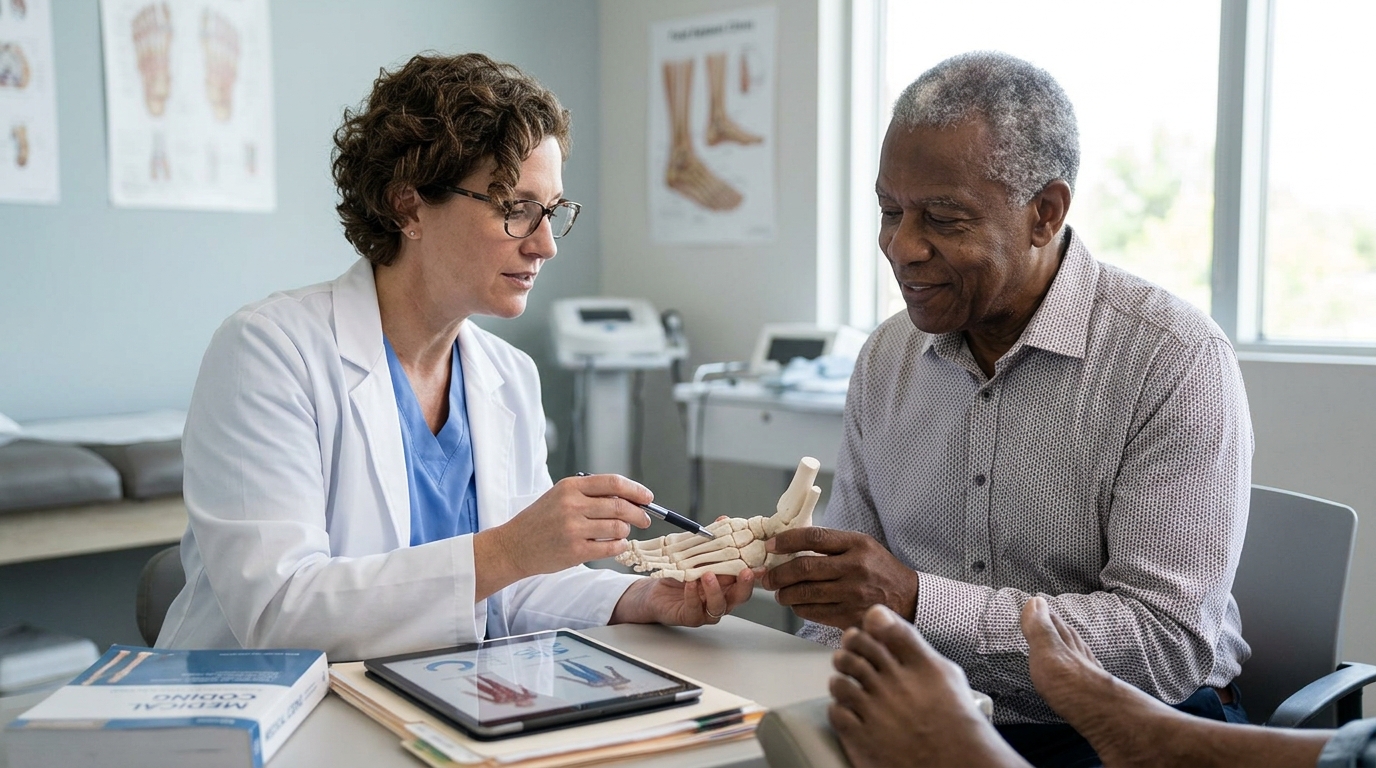
Orthopedic surgery billing demands precision. One missed detail in your documentation or an incorrect procedure code can trigger a claim denial, delay reimbursement, or expose your practice to compliance risk. For foot and ankle specialists, understanding the CPT code for Weil osteotomy is essential to maintaining a healthy revenue cycle in 2026.
What is Weil Osteotomy in Orthopedic Surgery?
Weil osteotomy is a surgical procedure that orthopedic surgeons and podiatric physicians perform to shorten or realign the metatarsal bones in the foot. Specifically, surgeons make an oblique bone cut through the metatarsal head, allowing them to slide the distal fragment proximally and fix it with a screw. This shortens the metatarsal, reduces pressure beneath the forefoot, and restores proper joint alignment.
Physicians commonly perform this procedure to treat:
- Metatarsalgia, chronic pain and inflammation under the ball of the foot
- Hammertoe deformities, where the toe bends abnormally at the middle joint
- Forefoot structural deformities, including dislocated or subluxed metatarsophalangeal (MTP) joints
Because the procedure involves precise bone work and internal fixation, coders must capture each surgical element accurately to ensure proper reimbursement.
Why Correct CPT Coding Matters in Orthopedic Billing
Accurate CPT coding does far more than satisfy administrative requirements, it directly protects your practice’s revenue. When billing teams submit the wrong code for a Weil osteotomy, payers either deny the claim outright or reimburse at a lower rate than the procedure warrants.
Furthermore, correct coding matters for these critical reasons:
- Preventing claim denials, Payers scrutinize orthopedic surgical codes carefully. An incorrect or vague code sends the claim straight to denial.
- Improving reimbursement accuracy, The right code ensures you receive the full allowed amount for the complexity of the procedure performed.
- Ensuring compliance, Improper coding, whether over-coding or under-coding, can trigger audits and compliance penalties.
For practices that partner with expert orthopedic billing companies like ROT Billing Services, having a coding team that understands procedure-specific nuances translates directly into reduced denials and accelerated cash flow.
CPT Code for Weil Osteotomy (Primary Coding Guide)
Standard CPT Code for Weil Osteotomy
Coders most commonly report Weil osteotomy under CPT code 28306 (Osteotomy, with or without lengthening, shortening or angular correction, metatarsal; first metatarsal) or CPT code 28307 (Osteotomy, with or without lengthening, shortening or angular correction, metatarsal; first metatarsal, with autograft). However, for lesser metatarsals (second through fifth), coders typically use CPT code 28308 (Osteotomy, with or without lengthening, shortening or angular correction, metatarsal; other than first metatarsal, each).
Because the CPT code for Weil osteotomy falls within the global surgical package, the reimbursement covers:
- The preoperative evaluation on the day of surgery
- The intraoperative procedure itself
- Routine postoperative care within the global period (typically 90 days)
Coders must avoid billing separately for services that fall within this global package. Additionally, when a surgeon performs the procedure on multiple metatarsals during the same operative session, append modifier -51 (Multiple Procedures) to the additional procedure codes.
Documentation Requirements for CPT Code Submission
Insurance payers will not reimburse a claim without a complete and detailed operative report. To successfully support a CPT code for Weil osteotomy, the operative note must include:
Bone cut details:
- Location and angle of the osteotomy
- Depth of the saw cut
- Amount of proximal displacement achieved
Metatarsal identification:
- Specific identification of which metatarsal(s) the surgeon operated on (first, second, third, etc.)
- Laterality (left foot or right foot)
Fixation method:
- Type of internal fixation used (e.g., cortical screw, mini-fragment screw)
- Size and number of screws placed
Beyond the operative note, coders must also link appropriate ICD-10-CM diagnosis codes to the CPT code to justify medical necessity. Without a supporting diagnosis, payers will deny the claim for lack of clinical rationale.
CPT Code for Weil Osteotomy Metatarsal
Coding Weil Osteotomy on Metatarsal Bone
When the Weil osteotomy involves the lesser metatarsals, coders report CPT 28308 for each metatarsal operated upon. The phrase “each” in the CPT descriptor is significant, it means you can report the code multiple times if the surgeon corrects more than one metatarsal. However, always append modifier -51 to the second and subsequent codes to signal multiple procedures to the payer.
Surgical approach variations can also affect code selection. For instance:
- If the surgeon performs the Weil osteotomy through a dorsal approach versus a plantar approach, the documentation must clearly support the technique used.
- If the surgeon combines the osteotomy with joint capsule repair or tendon work, coders may need to report additional codes, but must check bundling rules carefully.
Bundling considerations apply here as well. Under the National Correct Coding Initiative (NCCI), certain procedure code pairs are bundled, meaning you cannot bill them separately without a valid modifier. Coders must verify whether any additional procedure codes bundle with the metatarsal osteotomy code before submitting the claim.
Common Billing Errors in Metatarsal Osteotomy Coding
Despite the clear CPT guidance, billing teams frequently make avoidable errors when coding metatarsal osteotomies. The most common mistakes include:
- Incorrect bone specification, Failing to distinguish between first metatarsal (CPT 28306/28307) and lesser metatarsals (CPT 28308) results in improper code selection and potential overpayment or underpayment.
- Missing laterality documentation, Payers require coders to specify whether the procedure occurred on the left or right foot. Without this, many payers automatically deny the claim.
- Unbundling mistakes, Some coders mistakenly bill component parts of the Weil osteotomy as separate line items, which violates NCCI bundling rules and constitutes improper billing.
CPT Code for Weil Osteotomy Second Metatarsal
Specific Coding for Second Metatarsal Procedures
The second metatarsal is the most frequently involved bone in Weil osteotomy procedures. Clinically, this makes sense, the second metatarsal is typically the longest, and excess length causes the metatarsal head to bear disproportionate plantar pressure. This pressure leads to metatarsalgia, MTP joint synovitis, and eventually hammertoe formation.
Consequently, when coders encounter a Weil osteotomy claim, they should expect the second metatarsal to be the primary site. Coders report this procedure using CPT 28308, just as they would for any other lesser metatarsal. The key is ensuring the operative report clearly identifies the second metatarsal as the operative site.
Billing Guidelines for Second Metatarsal Osteotomy
From a payer perspective, second metatarsal Weil osteotomies are well-recognized procedures with established coverage policies. Nevertheless, coders must follow precise billing guidelines to avoid denials:
Documentation checklist for reimbursement:
- Surgeon’s pre-operative diagnosis identifying second metatarsal pathology
- Intraoperative findings confirming the clinical diagnosis
- Detailed description of the osteotomy cut and fixation
- Post-operative plan demonstrating medical necessity
Common denial reasons for second metatarsal claims:
- Lack of conservative treatment documentation prior to surgery (payers want evidence that non-surgical options failed)
- Missing or vague operative report
- Failure to link the CPT code to a specific ICD-10 diagnosis code
CPT Code for Weil Osteotomy Left Second Metatarsal
Importance of Laterality in Medical Coding
Laterality, that is, specifying the left or right side of the body, plays a critical role in orthopedic coding. Payers use laterality to track procedure history, apply bilateral surgery rules, and prevent duplicate billing. When a coder omits laterality from a Weil osteotomy claim, the payer cannot confirm which foot the surgeon operated on, and many payers will simply deny the claim.
Moreover, laterality affects ICD-10-CM code selection directly. The diagnosis codes for left foot conditions differ from those for right foot conditions, and the system specifically accounts for this distinction.
How to Report Left Second Metatarsal Weil Osteotomy
To correctly report a Weil osteotomy on the left second metatarsal, coders must follow this process:
Step 1, Select the correct CPT code: Report CPT 28308 for the left second metatarsal Weil osteotomy.
Step 2, Pair with the correct ICD-10 code: For a left foot metatarsalgia diagnosis, use ICD-10-CM M77.42 (Metatarsalgia, left foot). For second metatarsal stress fracture on the left, use M84.372A or an equivalent specific code based on clinical context.
Step 3, Confirm the operative note specifies the left foot: The surgeon’s documentation must unambiguously state “left foot” and identify the second metatarsal by name.
Step 4, Avoid duplicate billing errors: If the surgeon later operates on the right foot, coders must use a separate claim with distinct ICD-10 codes and clearly differentiated documentation to prevent a duplicate billing flag.
CPT Code for Weil Osteotomy with Hammertoe Correction
Combined Surgical Procedures Explained
Surgeons frequently perform Weil osteotomy together with hammertoe correction during the same operative session. This makes clinical sense, metatarsal overlengthening often causes the corresponding toe to buckle into a hammertoe deformity. Therefore, correcting the metatarsal without addressing the hammertoe would leave the patient with incomplete relief.
Common combined procedures include:
- Weil osteotomy of the second metatarsal plus proximal interphalangeal (PIP) joint arthroplasty for hammertoe correction
- Weil osteotomy plus flexor tendon lengthening
- Weil osteotomy plus MTP joint capsulotomy
Each of these combinations creates a distinct coding challenge, because coders must determine which procedures are separately billable and which are bundled under NCCI edits.
Coding Guidelines for Weil Osteotomy with Hammertoe Correction
When surgeons perform both a Weil osteotomy and a hammertoe correction during the same session, coders can often bill both procedures separately, but only if the following conditions apply:
- Each procedure addresses a distinct anatomical site or a distinct diagnosis
- The operative report documents each procedure separately with its own set of intraoperative findings
- NCCI edits do not bundle the two procedure codes together
Modifier usage in combined cases:
- Append modifier -59 (Distinct Procedural Service) or its more specific X-modifier variants (e.g., -XS for Separate Structure) when billing the hammertoe correction separately from the Weil osteotomy.
- Use modifier -51 for the secondary procedure when billing multiple procedures under the global surgical package rules.
NCCI edits considerations: Always run both CPT codes through an NCCI edit checker before submitting. Some hammertoe correction codes bundle with metatarsal osteotomy codes, and submitting without the correct modifier results in automatic denial.
Billing Challenges in Combined Foot Surgeries
Combined foot surgery claims create some of the most complex billing scenarios in orthopedic practice. Coders routinely encounter these challenges:
- Underpayment issues, Payers may downcode a combined surgical claim, reimbursing only for the primary procedure and ignoring the secondary one.
- Claim bundling denials, Without proper modifier documentation, payers bundle everything into a single payment, often at the lower rate.
- Documentation inconsistencies, When the operative report describes the procedures in an unclear order or lumps them together, coders cannot justify separate billing.
ICD-10 Codes Commonly Used with Weil Osteotomy
Diagnosis Codes Supporting Weil Osteotomy Claims
Pairing the correct ICD-10-CM code with the CPT code for Weil osteotomy is essential for demonstrating medical necessity. Commonly used diagnosis codes include:
| Condition | ICD-10-CM Code |
| Metatarsalgia, right foot | M77.41 |
| Metatarsalgia, left foot | M77.42 |
| Hammer toe(s) (acquired), right foot | M20.41 |
| Hammer toe(s) (acquired), left foot | M20.42 |
| Foot pain, right foot | M79.671 |
| Foot pain, left foot | M79.672 |
| Subluxation of MTP joint, right foot | M99.87 (or site-specific equivalent) |
Coders should always select the most specific ICD-10 code available. Vague or non-specific diagnosis codes raise red flags with payers and often lead to requests for additional documentation or outright denials.
Importance of ICD-10 and CPT Code Pairing
The relationship between the ICD-10 diagnosis code and the CPT procedure code must be clinically logical. Payers use automated algorithms to check whether the diagnosis code justifies the procedure code. Therefore, if a coder reports a hammertoe diagnosis but fails to include it as a linked diagnosis on the Weil osteotomy line item, the payer’s system may reject the claim.
Always ensure that:
- Every CPT code on the claim has at least one supporting ICD-10 code
- The ICD-10 code is as specific as possible (including laterality and stage where applicable)
- The diagnosis aligns with the clinical narrative in the operative report
Medical Billing Challenges in Weil Osteotomy Procedures
Frequent Claim Denials
Even when surgeons perform the procedure correctly and document it thoroughly, billing teams still encounter denials. The most frequent causes include:
- Missing operative notes, Some practices submit claims before the operative report is finalized, leading to automatic denials for missing documentation.
- Incorrect CPT selection, Using a first metatarsal code (CPT 28306) when the surgeon operated on the second metatarsal (CPT 28308) is a common and costly error.
- Lack of medical necessity proof, Payers expect to see documentation of conservative treatment failure (e.g., custom orthotics, cortisone injections, physical therapy) before approving surgical reimbursement.
How Medical Billing Companies Help Reduce Denials
Expert medical billing companies address these challenges systematically. They bring the infrastructure, trained staff, and payer-specific knowledge that in-house billing teams often lack. Specifically, billing companies help by:
- Managing prior authorizations, Submitting authorization requests with the correct clinical documentation before the surgical date
- Providing accurate CPT and ICD-10 coding, Using certified coders who specialize in orthopedic and podiatric surgery
- Running denial management workflows, Tracking denied claims, identifying root causes, and submitting corrected claims or appeals promptly
Best Practices for Orthopedic Medical Billing
Accurate Documentation Strategies
Surgeons and coding teams must collaborate closely to prevent billing errors. Surgeons should adopt these documentation habits:
- Dictate the operative report immediately after surgery, while details are fresh
- Specifically name each bone operated upon and identify the side (left/right)
- Describe the fixation method with enough detail to support the complexity of the procedure
Meanwhile, coding teams should:
- Verify that the CPT code selected matches the procedure described in the operative report
- Cross-reference the diagnosis codes against payer-specific coverage policies
- Run all code combinations through an NCCI edit tool before submission
Role of Expert Billing Companies like ROT Billing Services
Practices that partner with a specialized orthopedic billing company gain access to end-to-end revenue cycle management. ROT Billing Services offers:
- Specialized orthopedic billing expertise, Certified coders who understand the nuances of foot and ankle surgical coding
- Faster reimbursement cycles, Streamlined claim submission and follow-up processes that reduce payment turnaround time
- Reduced AR days, Proactive denial management and payment posting that keep accounts receivable aging under control
By outsourcing billing to experts, orthopedic and podiatric practices can focus on patient care while the billing team handles the complexity of coding, claims submission, and payer follow-up.
Conclusion
Importance of Accurate Coding in Orthopedic Billing
Orthopedic billing is among the most complex specialties in medical coding, and foot and ankle procedures sit at the heart of that complexity. The CPT code for Weil osteotomy demands precise documentation, careful code selection, and a deep understanding of payer-specific billing rules. From specifying the correct metatarsal to documenting laterality and applying the right modifiers for combined procedures, every detail influences whether your claim pays or denies.
As reimbursement rules evolve and payers tighten their documentation standards, practices that rely on outdated or generalist coding approaches will increasingly struggle with denials, appeals, and delayed revenue.
How ROT Billing Services Can Help
ROT Billing Services brings specialized orthopedic billing expertise to every claim. Their team of certified coders understands the nuances of CPT code selection for metatarsal osteotomies, hammertoe corrections, and combined foot surgeries. By partnering with ROT Billing Services, your practice benefits from:
- Accurate, compliant CPT and ICD-10 coding on every claim
- Proactive prior authorization management to prevent denials before surgery
- A dedicated denial management team that resolves rejected claims quickly
- Faster reimbursement cycles and lower accounts receivable aging
Ready to optimize your orthopedic billing? Contact ROT Billing Services today and let their experts handle the complexity of surgical coding, so you can focus on delivering exceptional patient care.