
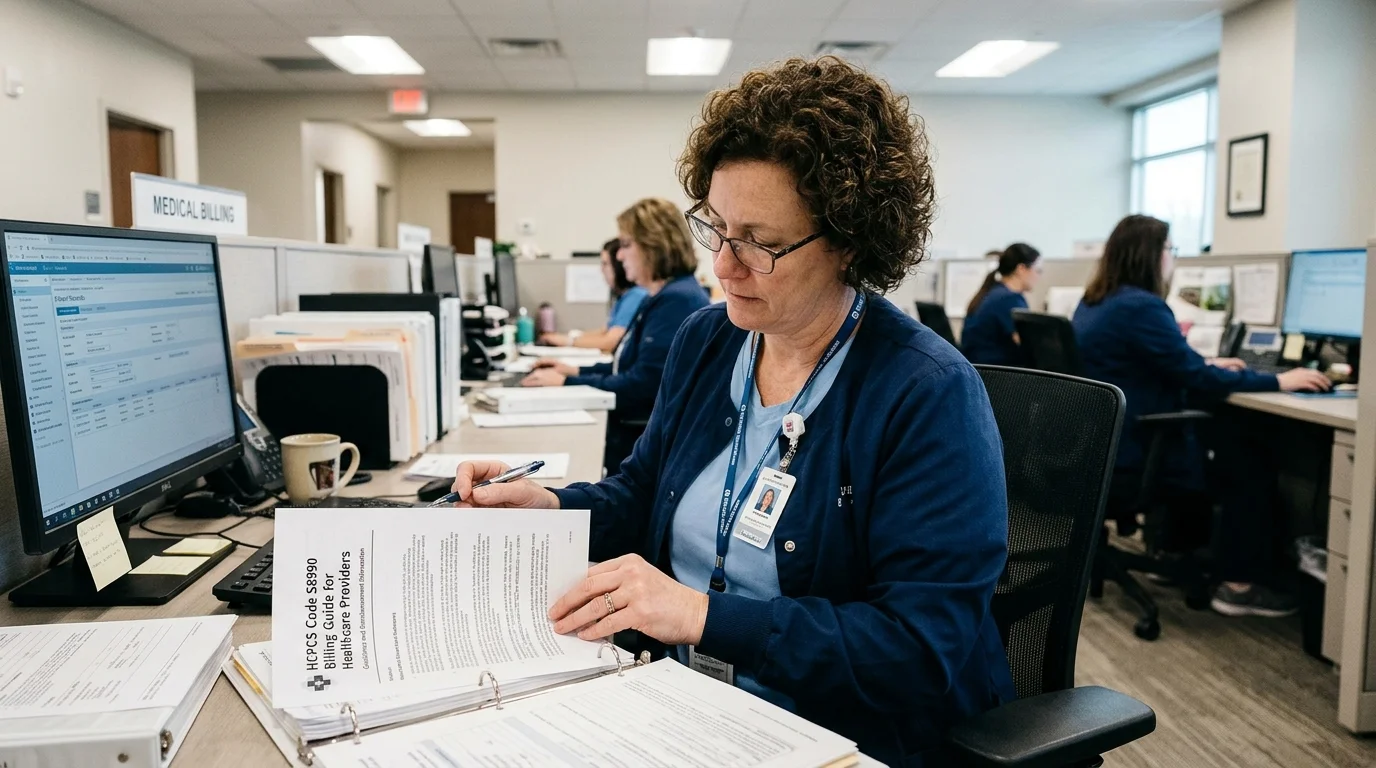
Accurate medical billing is the backbone of a financially healthy healthcare practice. Every service rendered must be coded correctly to ensure timely reimbursement, regulatory compliance, and minimal claim denials. Among the many codes used in healthcare billing, the HCPCS code S8990 requires careful attention from providers, coders, and billing teams alike.
Whether you are a physician, a medical coder, or a billing specialist, understanding the S8990 HCPCS code description, its billing guidelines, and its reimbursement requirements directly impacts your revenue cycle performance. This guide covers everything you need to know, from what the code means to how to avoid costly billing mistakes.
Introduction to HCPCS Code S8990
Why HCPCS Codes Matter in Medical Billing
HCPCS codes serve as the universal language of healthcare reimbursement. Insurance payers, government programs, and healthcare providers all rely on these codes to standardize billing procedures across the industry. When a provider submits a claim, the code tells the insurer exactly what service was delivered, what supply was used, or what procedure was performed.
Without standardized coding, reimbursement would become chaotic and inconsistent. Furthermore, coding accuracy directly determines whether a claim gets paid, partially reimbursed, or denied outright. Compliance also plays a critical role, incorrect coding not only delays payments but can also trigger audits and legal consequences.
Overview of the S8990 HCPCS Code
The S8990 HCPCS code falls within the HCPCS Level II coding system, which covers services, supplies, and equipment not typically found in standard CPT codes. Providers frequently search for the S8990 HCPCS code description to ensure they are submitting claims accurately and in line with payer expectations.
Because this code may be classified as miscellaneous or specialized in nature, it often requires additional supporting documentation before insurers will approve reimbursement. Therefore, understanding the details behind this code is not just helpful, it is essential.
Who Should Understand HCPCS Code S8990
Several healthcare professionals must be familiar with this code, including:
- Physicians who order or deliver the associated service
- Medical coders responsible for translating clinical documentation into billing codes
- Billing specialists who submit and track claims
- Revenue cycle management teams focused on maximizing collections
- Healthcare administrators overseeing compliance and financial performance
- Medical billing companies like Right On Time Billing Services that manage claims on behalf of providers
Importance of Accurate Coding for Reimbursement
Incorrect coding creates a ripple effect of financial problems. When coders assign the wrong code, insurers deny the claim, and providers lose revenue. Moreover, repeated coding errors can trigger compliance reviews and even fraud investigations.
Detailed, accurate documentation supports successful reimbursement by giving payers the evidence they need to approve claims. Consequently, providers who invest in coding accuracy experience fewer denials, faster payments, and stronger financial outcomes.
What Is HCPCS Code S8990?
Official HCPCS Code S8990 Description
The S8990 code is a HCPCS Level II code associated with physical or occupational therapy services, specifically relating to home care services and related supply or service categories. The official description covers services rendered to patients who require medically necessary care in specific clinical settings. Providers should always verify the most current description through the Centers for Medicare & Medicaid Services (CMS) or a current HCPCS code reference, as descriptions can be updated annually.
Understanding the Purpose of the S8990 Code
This code exists within the HCPCS system to capture and categorize services that fall outside the standard CPT framework. Insurers use the code during claim review to verify that the billed service matches the documented clinical scenario. Proper use of this code promotes transparent billing and reduces the likelihood of payer disputes.
Category and Classification of HCPCS Code S8990
HCPCS codes are divided into two main levels. Level I consists of CPT codes developed by the American Medical Association. Level II, where the S8990 HCPCS code belongs, covers services, equipment, and supplies that Medicare, Medicaid, and private insurers need to track but that CPT does not address.
Some HCPCS Level II codes are permanent, while others are temporary. The “S” prefix in S8990 indicates it belongs to a temporary code category used primarily by private insurers and some Medicaid programs.
How S8990 Differs From CPT Codes
CPT codes focus primarily on physician services and clinical procedures. HCPCS codes, on the other hand, extend to supplies, durable medical equipment, transportation services, and other non-physician services. Providers sometimes confuse these two systems, which leads to incorrect claim submissions. Understanding that HCPCS code S8990 operates within its own billing framework helps providers avoid this common mistake.
S8990 HCPCS Code Description Explained
Detailed Breakdown of the S8990 HCPCS Code Description
The S8990 code description covers specific services tied to home health or therapy-related care. Payers interpret each element of the description during their claims review process. Therefore, providers must understand the terminology within the description before submitting a claim. Each word in a HCPCS code description carries weight in how insurers evaluate medical necessity and service appropriateness.
Medical Services Commonly Linked With S8990
This code is commonly associated with home health services, therapy support, or related specialty care. Physical therapy practices, occupational therapy providers, and home care agencies may encounter this code during billing. Additionally, outpatient specialty clinics that serve patients requiring ongoing therapeutic or home-based care may find this code applicable to certain service categories.
Clinical Situations Where the S8990 Code Is Used
In real-world billing, providers may choose S8990 when a patient receives a service that fits the code’s description and when no more specific code exists. For example, if a therapy provider delivers a service that aligns with the S8990 description and the payer’s coverage policy supports it, billing this code becomes appropriate. However, providers must always check payer-specific requirements before using this code.
Why Proper Documentation Is Important for S8990 Claims
Physician notes, treatment plans, medical necessity statements, and supporting clinical reports all play a critical role in S8990 claim approval. When documentation is incomplete or vague, insurers have grounds to deny the claim. Therefore, providers must ensure that every element of the patient’s clinical record supports the billed service before submission.
When Should Providers Use HCPCS Code S8990?
Common Healthcare Settings for S8990 Usage
Providers across multiple settings may encounter this code, including:
- Outpatient clinics delivering specialty care
- Specialty practices in physical or occupational therapy
- Ambulatory care settings offering home health transitions
- Physician offices coordinating home-based care services
Physician and Facility Billing Scenarios
Physicians and facilities submit claims differently, and this distinction matters when billing S8990. Physicians typically submit claims on a CMS-1500 form, while facilities use the UB-04 form. Each payer may have specific instructions for which form to use, so verifying these requirements in advance prevents unnecessary rejections.
Outpatient and Specialty Care Applications
In outpatient and specialty settings, HCPCS codes often replace or supplement CPT codes when the service involves supplies or non-standard procedures. Some specialty services require HCPCS coding because CPT codes simply do not capture the full nature of what was provided. This is precisely where the S8990 code may become relevant.
Situations Where S8990 May Not Be Appropriate
Providers should avoid using S8990 when the service does not match the code description, when documentation is insufficient, when the payer’s policy excludes this code, or when a more specific code is available. Using a less specific or incorrect code increases the risk of denial and potential compliance issues.
Billing Guidelines for the S8990 HCPCS Code
Required Documentation for S8990 Claims
To successfully bill S8990, providers must maintain thorough documentation, including:
- Detailed physician notes describing the service
- Procedure details that match the code description
- A complete patient history relevant to the service
- Medical necessity records supporting the clinical decision
- Any supporting reports from therapists or specialists
Patient Records Needed for Accurate Billing
Beyond clinical notes, billing teams need diagnosis information, treatment plans, progress notes, and insurance eligibility verification. These records collectively build the case for reimbursement and reduce the chance of payer disputes.
Claim Submission Best Practices
Effective claim submission for S8990 involves several key steps. First, double-check coding accuracy before submission. Second, verify payer-specific policies for this code. Third, submit complete documentation along with the claim. Finally, monitor claim status after submission to catch and resolve issues quickly.
Modifiers Commonly Used With HCPCS Code S8990
Modifiers provide additional information about a service and can significantly affect reimbursement. Certain payers require specific modifiers when billing S8990 to clarify the nature of the service, the setting, or the provider type. Always review payer modifier requirements to avoid unnecessary denials.
Insurance Coverage and Reimbursement for HCPCS Code S8990
Does Medicare Cover HCPCS Code S8990?
Medicare coverage for S8990 depends on payer policy and medical necessity. Because the “S” prefix codes are primarily used by private insurers and some Medicaid programs, Medicare may not directly reimburse this code. Providers must check local coverage determinations and Medicare billing policies before submitting claims to avoid non-covered service denials.
Medicaid and Commercial Insurance Policies
Private insurers and Medicaid programs often have varying reimbursement rules for HCPCS codes. Some commercial payers cover S8990 under specific conditions, while others may require preauthorization. Medicaid policies also differ from state to state, so billing teams must verify eligibility and coverage at the state level.
Factors That Affect Reimbursement
Several factors influence whether a claim for S8990 gets paid, including documentation quality, proof of medical necessity, accurate diagnosis coding, timely filing, and adherence to payer-specific rules. Addressing each of these factors proactively leads to stronger reimbursement outcomes.
Prior Authorization Requirements for S8990
Some payers require prior authorization before a provider delivers the service associated with S8990. Submitting a claim without the required authorization almost always results in denial. Billing teams should build an authorization workflow into their process to ensure approvals are obtained before services are rendered.
Common Billing Errors Related to S8990 Code
Incorrect Documentation Issues
Missing physician signatures, incomplete treatment records, and absent supporting reports are among the most frequent documentation errors. Each of these gaps gives payers a reason to deny the claim, which delays payment and increases administrative burden.
Using the Wrong Diagnosis Codes
When diagnosis codes do not align with the billed procedure, payers flag the claim for medical necessity review. A mismatch between the diagnosis and the S8990 service can suggest that the treatment was unnecessary, which leads to denial or even audit scrutiny.
Missing Supporting Medical Necessity
Insurers require clear evidence that the billed service was medically necessary. When providers fail to include necessity documentation, claims are routinely denied. Billing teams must always confirm that clinical records explicitly justify why the service was needed.
Duplicate or Denied Claims Problems
Submitting duplicate claims, billing in the wrong sequence, making data entry mistakes, or encountering clearinghouse rejections all contribute to payment delays. Implementing a claim scrubbing process before submission significantly reduces these issues.
How to Avoid Claim Denials for HCPCS Code S8990
Verifying Payer Guidelines Before Submission
Each payer maintains specific billing guidelines, and these can change frequently. Billing teams should review payer policies regularly and check coding instructions specific to S8990 before submitting any claim.
Improving Coding Accuracy
Ongoing staff education, routine coding audits, updated coding resources, and internal claim review systems all contribute to improved accuracy. When coders have access to current information and institutional support, denial rates drop substantially.
Internal Auditing and Compliance Checks
Periodic internal audits help practices identify recurring billing weaknesses before they become costly problems. Compliance monitoring also protects providers from fraud allegations and ensures that coding practices align with industry standards.
Staff Training for Better Revenue Cycle Management
Well-trained billing staff make fewer errors, communicate more effectively with payers, and resolve denied claims faster. Investing in coder education and refining billing workflows leads to measurable improvements in collections and denial reduction.
Role of Medical Billing Companies in Managing S8990 Claims
How Professional Billing Services Reduce Errors
Professional billing companies use claim scrubbing tools, coding verification workflows, and denial prevention strategies to improve first-pass claim acceptance rates. These systems catch errors before claims reach the payer, saving providers time and money.
Benefits of Outsourcing Medical Billing
Outsourcing billing operations delivers several advantages, including reduced administrative burden, improved collections, faster reimbursements, and better compliance management. Providers can focus on patient care while billing experts handle the revenue cycle.
Faster Claim Processing and Payment Tracking
Electronic claim management systems allow billing companies to submit claims quickly, track payment status in real time, and follow up on unpaid or denied claims without delay. This accelerates cash flow and reduces accounts receivable days.
How Right On Time Billing Services Supports Providers
Right On Time Billing Services helps healthcare practices manage complex claims like S8990 with precision. Their team provides coding support, denial management, and revenue cycle optimization to ensure providers receive the reimbursement they deserve. By partnering with experienced billing professionals, practices reduce denials, improve compliance, and strengthen their financial performance. Learn more at rotbilling.com.
Conclusion
Final Thoughts on HCPCS Code S8990
Understanding the S8990 code is not optional for providers who want to protect their revenue and maintain compliance. Accurate coding, thorough documentation, and proactive payer verification are the three pillars of successful S8990 billing. When providers treat these as non-negotiable standards, claim approval rates improve and denials decrease.
Importance of Accurate Billing and Coding
Accurate billing and coding directly affect a practice’s financial stability and regulatory standing. Every denied claim represents lost revenue and wasted administrative effort. By prioritizing coding accuracy and documentation quality, providers protect both their income and their compliance record.
How Right On Time Billing Services Can Help Healthcare Providers
If managing complex HCPCS codes like S8990 feels overwhelming, professional support makes a meaningful difference. Right On Time Billing Services specializes in claims management, coding accuracy, denial resolution, and revenue cycle optimization for healthcare providers of all sizes.