
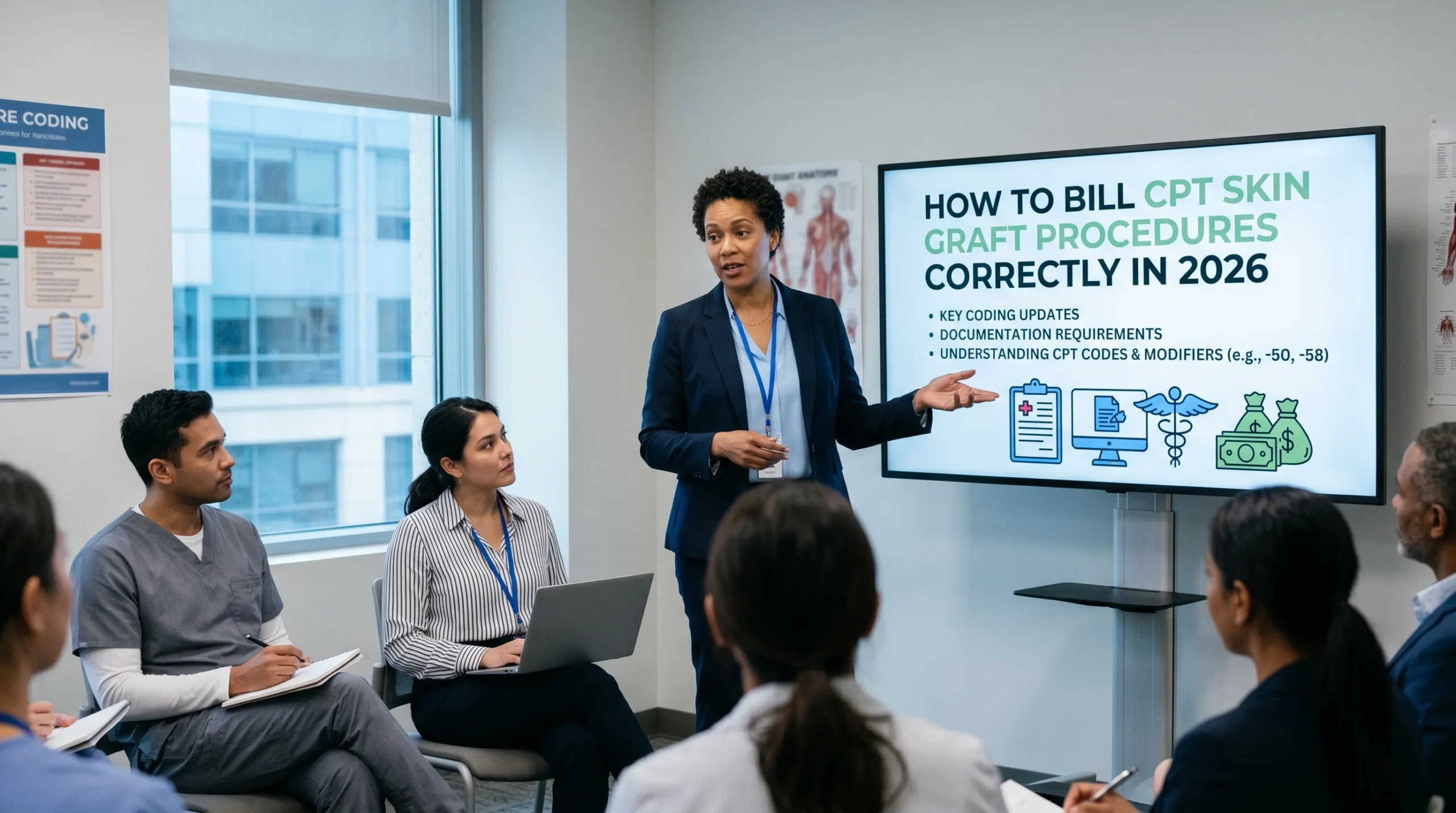
Medical billers often face challenges when coding skin graft procedures because CPT code selection depends on several factors, including graft type, wound size, anatomical location, and documentation quality. Even a small coding error can lead to claim denials, delayed reimbursements, and compliance concerns. Fortunately, understanding the coding structure and billing requirements can help you submit cleaner claims and improve reimbursement outcomes. This guide explains how to bill CPT skin graft procedures correctly, including split-thickness grafts, full-thickness grafts, and skin substitute applications.
What Is a Skin Graft Procedure?
A skin graft procedure involves surgically transferring skin from one area of the body to another to cover a wound, injury, burn, or surgical defect. Physicians commonly perform skin grafts when a wound cannot heal properly through primary closure.
The primary goal is to restore tissue coverage, accelerate healing, reduce infection risk, and improve cosmetic outcomes. Depending on the clinical situation, surgeons may use autografts, allografts, or skin substitute products.
Common Conditions Requiring Skin Grafts
Healthcare providers frequently perform skin graft procedures for:
- Burn injuries
- Traumatic wounds
- Chronic ulcers
- Diabetic foot ulcers
- Pressure injuries
- Post-Mohs surgical defects
- Reconstructive surgery
- Extensive skin loss
Types of Skin Grafts Used in Clinical Practice
- Split-Thickness Skin Grafts (STSG) contain the epidermis and part of the dermis. Providers often use them for large wounds and burn treatment.
- Full-Thickness Skin Grafts (FTSG) contain the epidermis and entire dermis. Surgeons commonly use them in facial reconstruction and cosmetically sensitive areas.
- Allografts involve donor tissue and often provide temporary wound coverage.
- Skin Substitutes include biologic and synthetic products designed to support wound healing and tissue regeneration.
Understanding CPT Skin Graft Coding Categories
Accurate coding begins with understanding how CPT skin graft codes are organized. Code selection depends on:
- Type of graft
- Anatomical location
- Surface area treated
- Procedural complexity
Split-Thickness Skin Graft CPT Codes
Split-thickness skin graft codes apply when the surgeon transfers a graft containing the epidermis and a portion of the dermis.
These procedures commonly treat:
- Burn wounds
- Traumatic injuries
- Lower-extremity defects
- Large wound surfaces
When assigning a split thickness skin graft CPT code, coders must evaluate the recipient site and the total wound area documented in square centimeters.
Full-Thickness Skin Graft CPT Codes
Full-thickness skin graft CPT codes apply when the surgeon transfers skin containing both the epidermis and full dermis.
These procedures commonly address:
- Facial defects
- Eyelid reconstruction
- Nasal repairs
- Finger injuries
- Cosmetic reconstruction
Because cosmetic outcomes are important, code selection often depends heavily on anatomical location and graft size.
Skin Substitute Graft CPT Codes
Skin substitute graft codes apply to bioengineered tissues, cellular products, and synthetic wound-healing materials.
Unlike traditional autografts, skin substitutes do not require harvesting skin from the patient. However, coding requirements differ significantly from those used for autologous skin grafts.
Step-by-Step Guide to Choosing the Correct Skin Graft CPT Code
Step 1: Determine the Type of Graft
First, identify the graft category:
- Autograft
- Allograft
- Skin substitute
- Synthetic graft
The graft type determines the coding family you will use.
Step 2: Identify the Anatomical Location
Next, determine the recipient site.
Common anatomical locations include:
- Face
- Nose
- Eyelid
- Finger
- Hand
- Leg
- Foot
- Trunk
Many CPT skin graft codes vary by body region.
Step 3: Calculate the Total Surface Area
Accurate wound measurement remains one of the most important coding requirements.
Providers must document the treated area clearly in square centimeters. Incorrect measurements often result in coding errors and reimbursement issues.
Step 4: Determine Whether Add-On Codes Apply
Many graft procedures include base codes and add-on codes.
When the treated area exceeds established thresholds, coders must report additional units according to CPT guidelines.
Step 5: Review Bundling Rules
Before submitting a claim, review any related procedures performed during the same operative session.
Some services may be bundled into the primary graft procedure, while others may qualify for separate reimbursement when documentation supports medical necessity.
CPT Codes for Split-Thickness Skin Grafts (STSG)
Split-thickness skin grafts are among the most frequently performed grafting procedures.
When Split-Thickness Skin Grafts Are Used
Providers commonly choose split-thickness grafts for:
- Extensive burns
- Traumatic wounds
- Lower-extremity ulcers
- Large skin defects
These grafts provide efficient wound coverage while requiring less donor tissue.
Common Coding Considerations
Several factors affect code selection:
- Surface area
- Recipient site location
- Additional grafted areas
- Documentation quality
Coders should always verify measurements before assigning a split thickness skin graft CPT code.
Coding Example
A patient presents with a traumatic lower-leg wound measuring 120 square centimeters.
The surgeon performs a split-thickness skin graft.
The coder must identify the appropriate primary CPT code and determine whether add-on reporting is necessary based on the documented surface area.
CPT Codes for Full-Thickness Skin Grafts (FTSG)
Full-thickness grafts often provide superior cosmetic and functional outcomes.
When Full-Thickness Grafts Are Appropriate
Surgeons frequently perform these procedures for:
- Facial reconstruction
- Nasal defects
- Eyelid repairs
- Finger injuries
- Cosmetic restoration
These grafts typically produce improved color match and tissue quality.
Anatomical Site Considerations
The recipient site significantly affects CPT code selection.
Common sites include:
- Nose
- Eyelid
- Finger
- Cheek
- Ear
- Lip
Each location may have different coding requirements.
Coding Example
A patient undergoes nasal reconstruction following skin cancer excision.
The surgeon repairs the defect using a full-thickness skin graft.
The coder must evaluate the graft size, defect dimensions, and anatomical site before selecting the appropriate full thickness skin graft CPT code.
Skin Substitute Graft Billing Guidelines
Skin substitute procedures continue to play a growing role in wound management.
What Is a Skin Substitute?
A skin substitute is a biologic or synthetic product designed to replace or support damaged tissue.
Providers often use these products for chronic wounds that have not responded to traditional treatment.
Common Skin Substitute Products
Several products appear frequently in wound care practices:
- Integra
- AlloDerm
- ACell
- Epifix
- Oasis
- Amniox
Each product may have unique payer requirements and documentation standards.
Coding Considerations for Skin Substitute Applications
When billing skin substitute procedures, providers should document:
- Wound location
- Surface area
- Product applied
- Amount used
- Medical necessity
Many payers also require detailed treatment histories before approving reimbursement.
Documentation Requirements for Accurate Skin Graft Billing
Strong documentation supports coding accuracy and reimbursement success.
Essential Information Required in the Operative Note
The operative report should include:
- Diagnosis
- Recipient site
- Donor site
- Wound dimensions
- Graft dimensions
- Procedure details
- Surgical technique
- Postoperative plan
Missing information may increase denial risk.
Medical Necessity Documentation
Providers should clearly explain why the skin graft was required.
Documentation should support the clinical need for graft placement and describe previous treatment attempts when applicable.
Surface Area Documentation
Accurate measurements remain critical.
Payers often review wound dimensions carefully because many skin graft CPT codes depend on treated surface area.
Common Modifiers Used for CPT Skin Graft Procedures
Proper modifier usage helps ensure accurate claim processing.
| Modifier | Purpose |
| 22 | Increased procedural services |
| 51 | Multiple procedures |
| 59 | Distinct procedural service |
| LT | Left side |
| RT | Right side |
| 78 | Return to operating room |
| 79 | Unrelated procedure during postoperative period |
Always verify payer-specific modifier requirements before claim submission.
Common Skin Graft Billing Mistakes and Claim Denials
Many claim denials result from avoidable coding errors.
Incorrect Surface Area Calculations
- Inaccurate measurements often lead to incorrect CPT code assignment.
- Coders should verify all calculations before submitting claims.
Selecting the Wrong Graft Category
- Confusing autografts, allografts, and skin substitutes remains a common mistake.
- Always confirm the graft type documented by the surgeon.
Missing Documentation
- Incomplete operative reports frequently trigger payer requests and denials.
- Providers should document all required procedural details.
Incorrect Modifier Usage
- Improper modifier application can delay payment or generate claim rejections.
- Coders should review payer policies carefully.
Billing Unbundled Services
- Attempting to bill separately for bundled services may create compliance concerns and increase audit risk.
Real-World Skin Graft Billing Examples
Example 1: Split-Thickness Skin Graft
A patient undergoes treatment for a traumatic leg wound.
The surgeon performs a split-thickness skin graft covering a large wound area.
The coder reviews the operative report, confirms the recipient site, measures the total surface area, and assigns the appropriate base and add-on codes.
Example 2: Full-Thickness Skin Graft
A patient requires nasal reconstruction following lesion removal.
The surgeon uses a full-thickness skin graft to repair the defect.
The coder determines code selection based on anatomical location and documented graft size.
Example 3: Skin Substitute Application
A patient presents with a chronic diabetic foot ulcer.
The physician applies a skin substitute product to promote healing.
The coder documents the product used, wound measurements, and application details before selecting the correct reporting codes.
Conclusion
Accurate CPT skin graft billing requires careful code selection, thorough documentation, and a clear understanding of graft classifications. Whether reporting split-thickness skin grafts, full-thickness skin grafts, or skin substitute applications, providers must document wound measurements, anatomical location, and medical necessity in detail. Additionally, proper modifier usage and compliance with payer guidelines can help reduce denials and improve reimbursement outcomes. By following established coding principles and maintaining complete operative documentation, healthcare organizations can strengthen claim accuracy and support long-term revenue cycle performance.