
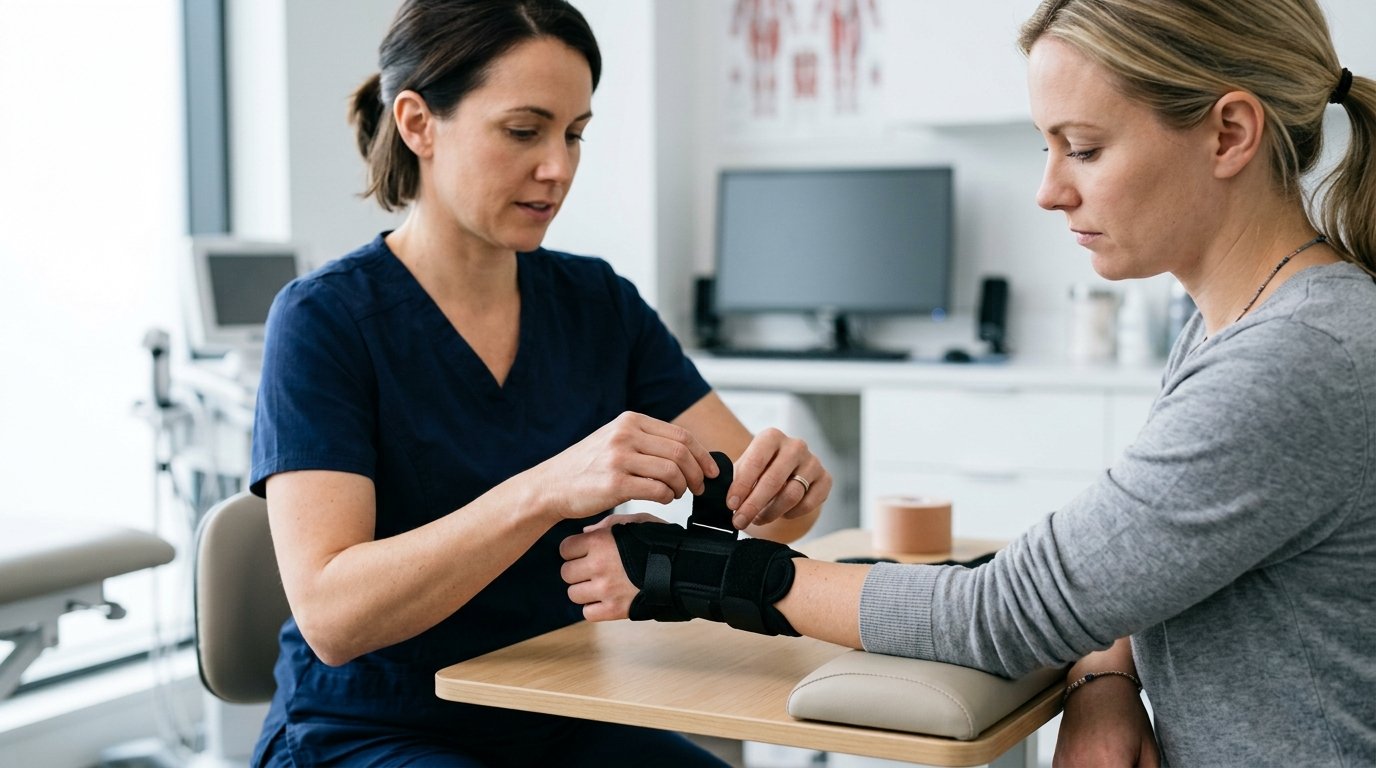
Many billers search for one simple answer: what is the CPT code for a wrist brace? However, there is no single universal CPT code for wrist brace billing. Coding depends on the exact item provided and the service performed. A provider might dispense a physical orthosis, apply a splint, or deliver orthotic management training. The device itself may be prefabricated, custom-fitted, or custom-fabricated, and each option changes the code.
This distinction matters because wrist orthoses often fall under HCPCS Level II L-codes. Meanwhile, CPT codes typically describe the professional service tied to applying or managing that orthosis. Understanding this split prevents costly claim errors. Right On Time Billing Services helps medical practices navigate these nuances and submit accurate, defensible claims.
Is There a CPT Code for a Wrist Brace?
Let’s answer this directly. CPT codes primarily describe procedures and professional services, not physical items. HCPCS Level II codes, on the other hand, describe orthotic devices and DMEPOS items. Therefore, a wrist brace is usually represented by an L-code rather than a true wrist brace CPT code. A separate CPT code may apply when documentation supports an actual application, fitting, training, or management service. CMS maintains DMEPOS fee schedules and HCPCS listings that define these orthotic devices. Getting this distinction right is the foundation of accurate wrist brace CPT code selection.
Wrist Brace CPT Code vs. Wrist Brace HCPCS Code
This comparison sits at the heart of accurate billing.
What Is a CPT Code?
CPT stands for Current Procedural Terminology. These codes describe medical, surgical, and diagnostic services performed by providers. CPT codes communicate what a clinician actually did during an encounter. They do not typically describe physical supplies or devices.
What Is a HCPCS Level II Code?
HCPCS Level II codes cover items CPT does not address well. These include orthotics, prosthetics, and other DMEPOS supplies. A wrist brace, as a physical product, generally fits into this category.
Why Wrist Braces Often Use HCPCS L-Codes
The device itself is usually represented by an L-code, not a CPT code. CMS lists several wrist-hand orthosis codes, including L3905, L3906, L3908, L3915, and L3916. These codes differ based on the orthosis type and its mechanical configuration. Consequently, choosing the right L-code requires close attention to product details.
Common Codes Used for Wrist Braces and Wrist Orthoses
The table below offers a general reference for common codes.
| Code | General Coding Purpose |
| L3908 | Wrist-hand orthosis, wrist extension control/cock-up, non-molded, prefabricated, off-the-shelf |
| L3905 | Wrist-hand orthosis with specified non-torsion joint features, custom fabricated, including fitting/adjustment |
| L3906 | Wrist-hand orthosis without joints, custom fabricated, including fitting/adjustment |
| L3915 | Wrist-hand orthosis with one or more non-torsion joints, prefabricated/custom-fitted category |
| L3916 | Wrist-hand orthosis with specified non-torsion joint features, prefabricated/off-the-shelf category |
| 29125 | Application of a short-arm/forearm splint, static |
| 29126 | Application of a short-arm/forearm splint, dynamic |
| 97760 | Orthotic management/training when documentation meets CPT requirements |
CMS identifies these codes within its orthotic and splint coding materials. However, this table is not a universal “pick this code” chart. The correct choice always depends on the device, fabrication method, and documentation. Payer policy also plays a major role in final code selection.
L3908 — A Common Code for an Off-the-Shelf Wrist Brace
This code deserves closer attention because it matches frequent search intent.
What Is HCPCS Code L3908?
CMS describes L3908 as a wrist-hand orthosis for extension control or cock-up support. The device must be non-molded, prefabricated, and off-the-shelf. This code applies specifically to that product category.
When Might L3908 Be Appropriate?
L3908 may fit a standard cock-up wrist orthosis in many cases. It can also apply to certain off-the-shelf wrist supports and stabilization devices. Still, not every wrist brace for pain or tendonitis maps to L3908 automatically. The specific product features must match the code descriptor.
What Documentation Should Support L3908?
Solid documentation should establish medical necessity clearly. It should also include the diagnosis, orthosis type, and laterality. Coders should confirm the device is truly prefabricated and off-the-shelf. Ordering provider details and dispensing information matter as well. Supporting clinical notes strengthen every wrist brace CPT code claim.
Other Wrist Brace HCPCS Codes to Know
Different device configurations require different codes entirely.
L3905 — Custom-Fabricated Wrist-Hand Orthosis
Custom fabrication changes code selection significantly. CMS describes L3905 as a wrist-hand orthosis with specified joint components. This code is custom fabricated and includes fitting and adjustment work.
L3906 — Wrist-Hand Orthosis Without Joints
A custom-fabricated wrist-hand orthosis without joints may fall under L3906. This category depends on the device’s actual construction, not its brand name. Coders should verify joint presence before selecting this option.
L3915 and L3916 — Prefabricated Wrist-Hand Orthoses
These codes require careful attention to device characteristics and fitting category. A product is not automatically L3915 or L3916 simply because it’s called a wrist brace. CMS materials list both codes among recognized wrist-hand orthotic options.
CPT 29125 for Wrist Splint Application
Coders must separate the brace itself from the service of applying it. CMS currently lists 29125 as application of a short-arm or forearm splint, static.
When Is 29125 Relevant?
This code may apply when a provider performs an actual splint application. It differs from simply dispensing an off-the-shelf orthosis to a patient. The clinical action performed determines whether 29125 fits the encounter.
29125 vs. a Wrist Orthosis L-Code
This comparison often captures valuable search traffic and reader confusion. Device coding and procedure coding serve two very different purposes. A splint application differs from orthosis dispensing in documentation terms. Payer-specific rules ultimately decide how these codes interact on a claim.
CPT 29126 for Dynamic Forearm/Wrist Splint Application
Static and dynamic splint applications require different codes. CMS’s current coding materials identify 29126 as application of a dynamic short-arm splint. Coders should always verify the current CPT descriptor before billing. Payer-specific billing rules can also affect whether 29126 applies correctly.
CPT 97760 and Wrist Orthotic Management
This code creates frequent confusion among billing teams.
What Is CPT 97760?
CPT 97760 concerns orthotic management and training services. It does not represent the physical wrist brace itself. Instead, it captures the clinical work of managing a device’s use.
What Can Orthotic Management Include?
This service can include patient assessment and orthosis fitting. It often covers patient education about using the device correctly. Wearing schedules, care instructions, and functional training also fall under this code. AAPC’s coding guidance describes 97760 as a management and training service. Documentation must clearly support each component billed under this code.
Can 97760 Be Billed With a Wrist Brace Code?
This question has no automatic yes-or-no answer. Providers must examine the actual service performed during the visit. The orthosis code’s descriptor and existing documentation matter greatly here. NCCI edits and payer policy also affect this decision directly. CMS notes that 29125, 29126, and 97760 may not always apply separately. This restriction applies when the splint code already includes fitting.
CPT Code for Wrist Brace by Type of Brace
Different brace types often require different coding logic.
Cock-Up Wrist Brace
L3908 may be relevant for an appropriate off-the-shelf cock-up orthosis. The device’s actual construction still determines final code selection.
Carpal Tunnel Wrist Brace
The diagnosis alone does not determine the correct orthosis code. Coders must still evaluate the device’s fabrication and mechanical features.
Custom Wrist Brace
Fabrication method and device construction drive code selection here. A truly custom device requires custom-fabrication codes like L3905 or L3906.
Prefabricated Wrist Brace
Prefabricated categories differ meaningfully from custom-fabricated devices. Coders should confirm whether the item is off-the-shelf or custom-fitted.
Wrist-Hand-Finger Orthosis
Some products extend beyond the wrist into the hand and fingers. These devices may require different HCPCS descriptions entirely.
How to Choose the Correct Wrist Brace Code
Follow this seven-step workflow for accurate results.
Step 1 — Identify the Exact Device
Determine whether the item is a wrist brace or splint. Consider whether it’s a wrist-hand or wrist-hand-finger orthosis instead.
Step 2 — Determine Fabrication Type
Confirm whether the device is off-the-shelf, prefabricated, custom-fitted, or custom-fabricated. This single detail changes the entire coding path.
Step 3 — Determine the Mechanical Features
Look closely for joints, non-torsion components, and extension control features. Also check for dynamic components, straps, and soft interfaces.
Step 4 — Determine the Service Provided
Identify whether the provider dispensed, applied, fitted, trained, or managed. Each action points toward a different code category.
Step 5 — Review Documentation
Confirm the medical record supports every element of the chosen code. Incomplete documentation often leads to denials later.
Step 6 — Check Payer Policy
Verify coverage rules before submitting any wrist brace CPT code claim. Payer policies frequently differ from general CMS guidance.
Step 7 — Verify the Current Code Set Before Claim Submission
Descriptors and fee schedules change over time regularly. CMS publishes current DMEPOS fee schedules and coding updates often. Always confirm the latest code set before final submission.
Documentation Requirements for Wrist Brace Billing
Strong documentation protects every claim submitted.
Medical Necessity
Records should clearly justify why the device was needed.
Diagnosis and Clinical Findings
The chart should link the diagnosis to the orthosis choice.
Physician/Qualified Practitioner Order
A valid order should authorize the specific device dispensed.
Description of the Orthosis
Notes should describe the device’s type and construction clearly.
Laterality
Records must specify which wrist received the orthosis.
Fitting or Adjustment Documentation
Any fitting or adjustment work should appear in the chart.
Patient Education and Training
Training sessions should be documented with specific details included.
Delivery/Dispensing Documentation
Records should confirm when and how the device was delivered.
Proof of Custom Fabrication, When Applicable
Custom devices require documentation proving true custom construction. These requirements often vary by payer and specific code selected.
Common Wrist Brace Billing and Coding Mistakes
These errors appear frequently across practices.
Mistake #1 — Calling Every Wrist Brace a CPT Code
Many billers confuse CPT and HCPCS categories entirely. This mistake leads directly to inaccurate wrist brace CPT code claims.
Mistake #2 — Using L3908 for Every Wrist Brace
Product characteristics, not convenience, should drive code selection always.
Mistake #3 — Choosing a Code Based Only on Diagnosis
Diagnosis alone never determines the correct orthosis code.
Mistake #4 — Ignoring Custom vs. Prefabricated Status
This distinction changes both the code and reimbursement amount.
Mistake #5 — Separately Billing Included Fitting
CMS highlights this issue for splints with bundled fitting services.
Mistake #6 — Missing Laterality or Claim-Line Requirements
Missing details like laterality often trigger unnecessary claim denials.
Mistake #7 — Using Outdated Coding Information
Codes and descriptors change, so outdated references cause billing errors.
Wrist Brace Coding Examples
These realistic examples illustrate common coding scenarios.
Example 1: Off-the-Shelf Cock-Up Wrist Brace. A patient receives a standard prefabricated wrist-hand orthosis. L3908 may be considered here, subject to device and payer rules.
Example 2: Custom-Fabricated Wrist Orthosis. A patient requires a custom-fabricated device for their condition. A custom L-code category may fit better than an off-the-shelf option.
Example 3: Static Short-Arm Splint Application. A provider applies a static short-arm splint during the visit. CMS identifies 29125 within its current procedural coding materials.
Example 4: Dynamic Splint Application. A provider applies a dynamic splint requiring different mechanical support. This scenario points toward CPT 29126 for the procedure.
Example 5: Orthotic Management and Training. A provider documents thorough orthotic management and training work. CPT 97760 may apply here, but never automatically alongside an orthosis code.
Wrist Brace CPT Code for Medicare
Medicare rules add another layer of complexity.
Medicare Part B covers many DMEPOS items under specific conditions. Wrist braces typically fall under HCPCS L-codes for classification purposes. Medical necessity and documentation remain essential for every claim. CMS maintains DMEPOS fee schedules that guide reimbursement amounts. Supplier requirements also apply to anyone dispensing these devices. Reasonable useful lifetime rules can affect replacement device coverage too. Reviewing current CMS policy prevents avoidable claim denials.
Wrist Brace Coding for Other Insurance Payers
Medicare rules should never be assumed universal across payers. Commercial insurance, Medicaid, and Medicare Advantage each maintain distinct policies. Workers’ compensation and auto insurance plans add further variation. Managed care plans often layer additional requirements onto claims.
Before submitting a claim, billers should verify coverage carefully. Prior authorization requirements deserve confirmation for every payer involved. Medical policy documents often outline specific coding expectations directly. Documentation, allowed amounts, and submission requirements should all be checked.
CPT Code Wrist Brace — Quick Reference Table
| Question | What to Verify |
| Is it a brace or splint? | Identify the actual device |
| Is it off-the-shelf? | Check the HCPCS descriptor |
| Is it custom fabricated? | Verify the fabrication method |
| Does it include fitting? | Review the code descriptor |
| Was a splint applied? | Consider the applicable CPT code |
| Was orthotic management performed? | Review CPT 97760 requirements |
| Is it Medicare? | Check current CMS policy |
| Is it commercial insurance? | Verify payer-specific policy |
| Is laterality required? | Review claim instructions |
| Is documentation complete? | Confirm medical necessity and details |
How Right On Time Billing Services Can Help With Orthotic Billing
Accurate wrist brace CPT code selection requires ongoing expertise and attention. Right On Time Billing Services supports practices with medical billing and coding. The team assists with orthopedic billing and DME/DMEPOS billing needs. Services include claim submission, denial management, and AR follow-up. Eligibility and benefits verification help prevent avoidable claim delays. Documentation review and coding accuracy audits strengthen every submission. Insurance verification further reduces the risk of denied claims.
Accurate wrist brace billing starts with accurate code selection every time. Complete documentation and payer-specific verification support that accuracy directly. Right On Time Billing Services helps healthcare organizations streamline these processes. This approach reduces avoidable claim issues across the entire billing cycle.
Final Takeaway
There is no single universal CPT code for wrist brace billing. The correct approach depends on exactly what was coded. Coders might address the orthotic device itself directly. They might instead code a splint application procedure. Orthotic management and training represent another possible service category. Each scenario requires its own documentation and code selection.
This guide highlights the important distinction between CPT and HCPCS Level II codes when billing for wrist braces and orthoses. While L-codes such as L3908 may apply to certain wrist-hand orthoses, the appropriate code depends on the device’s specific features, fabrication method, and the service provided. Accurate documentation, medical necessity, and payer-specific requirements are essential for supporting claims, reducing avoidable denials, and ensuring accurate reimbursement.
Frequently Asked Questions (FAQs)
Get clear and concise answers about the CPT code for wrist braces, including applicable coding options, documentation requirements, medical necessity, billing guidelines, coverage considerations, and common coding errors that can lead to claim denials.
There is no single universal CPT code for a wrist brace. The physical orthotic device is generally reported using an appropriate HCPCS Level II L-code, while CPT codes may describe services such as splint application, orthotic management, fitting, or training. The correct code depends on the device and service provided.
L3908 may apply to certain non-molded, prefabricated, off-the-shelf wrist-hand orthoses designed for wrist extension control or cock-up support. However, the product’s actual characteristics must match the code descriptor. Providers should verify the current code description and applicable payer requirements before submitting a claim.
CPT codes generally describe professional procedures and services performed by healthcare providers. HCPCS Level II codes are commonly used to report supplies, orthotics, prosthetics, and DMEPOS items. Therefore, the wrist brace itself may require an L-code, while a service such as splint application or orthotic management may require a CPT code.
CPT 29125 describes the application of a static short-arm or forearm splint. It may be appropriate when a provider actually performs the documented splint application. It should not automatically be used simply because a patient receives a wrist brace, and payer-specific rules should be reviewed before billing.
Documentation should support medical necessity and identify the diagnosis, specific orthosis provided, laterality, fabrication method, and relevant clinical findings. Depending on the device and payer, records may also need an order, fitting or adjustment details, delivery information, and documentation supporting custom fabrication when applicable.
Common mistakes include treating every wrist brace as a CPT code, selecting L3908 without verifying the device characteristics, confusing custom-fabricated and prefabricated orthoses, relying solely on the diagnosis to select a code, separately billing services that may already be included, and using outdated coding information. Reviewing the current code set and payer policy can help reduce avoidable denials.