
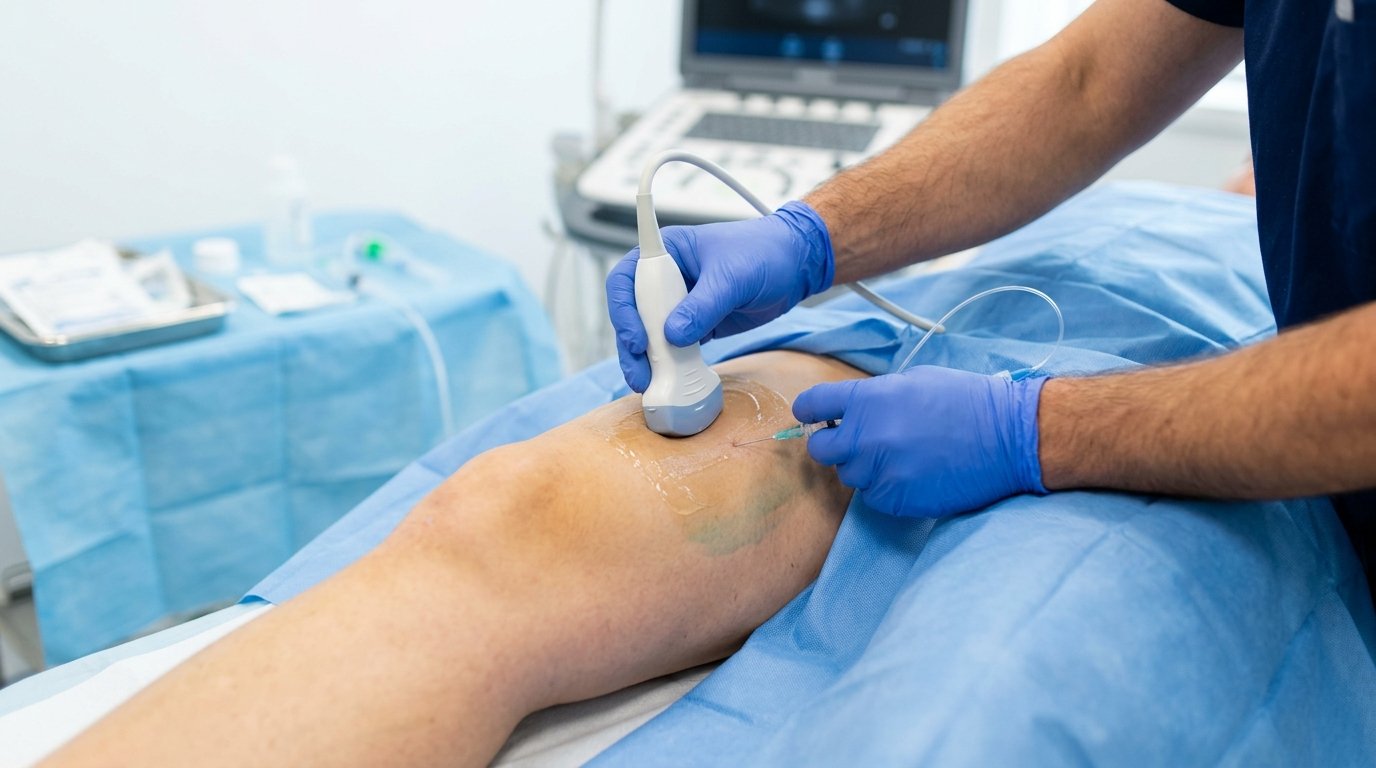
Adductor Canal Block CPT Code Selection: 64447 vs. 64448
CPT 64447 for a Single-Shot Adductor Canal Block
Providers generally report 64447 for a documented single-shot adductor canal block. This service falls within the femoral nerve injection code family. Therefore, the clinical procedure name may differ from the code’s anatomical terminology. Review the complete procedure note before selecting the adductor canal block CPT code. A single injection can provide extended relief. Nevertheless, its duration does not convert the procedure into continuous infusion.CPT 64448 for a Continuous Adductor Canal Block
Providers generally report 64448 when they place a catheter for continuous adductor canal infusion. The code includes catheter placement. Consequently, coders should confirm catheter insertion and the intended infusion technique. A long-lasting medication alone does not support continuous-block reporting.The AMA’s published code materials distinguish injection services from continuous catheter delivery. They also identify included imaging guidance. AMACode Comparison Table
Use this comparison when reviewing the documented technique:| Documented service | Code generally considered | Essential documentation |
| Single-shot adductor canal block | 64447 | Target, injection technique, laterality |
| Continuous adductor canal infusion | 64448 | Catheter placement, infusion plan |
| Single-shot popliteal sciatic block | 64445 | Separate sciatic target and injection |
| Continuous popliteal sciatic infusion | 64446 | Sciatic catheter and infusion details |
Anatomical Documentation That Supports the Correct CPT Code for Adductor Canal Block
Adductor Canal, Saphenous Nerve, and Femoral Nerve Terminology
The saphenous nerve branches from the femoral nerve and travels through the adductor canal. However, these related terms describe different anatomical details. A note stating “femoral block” may describe a different approach from an adductor canal injection. Accordingly, confirm the documented location.Accurate adductor canal block CPT code selection depends on the procedure narrative rather than a scheduling label.Adductor Canal Saphenous Block vs. Distal Saphenous Block
A distal saphenous injection differs anatomically from an injection within the adductor canal. Therefore, avoid assigning identical codes automatically. An isolated distal branch block may require consideration of 64450, depending on the documented service and applicable instructions. When terminology conflicts, request clarification. Ask the provider to identify the injection location, intended nerve, and delivery technique.Documentation Gaps That Require Clarification
Resolve these problems before finalizing the claim:- An unspecified “leg nerve block.”
- Missing injection location.
- Unclear catheter use.
- Conflicting right-side and left-side entries.
- Different procedures in the title and narrative.
Single-Shot Adductor Canal Block Coding and Documentation
Procedure Details That Support CPT 64447
A complete procedure note connects the clinical indication with the injection performed. It should identify:- Reason for treatment.
- Side treated.
- Anatomical target and approach.
- Medication, concentration, and volume.
- Injection technique.
- Imaging use, when applicable.
- Patient response and complications.
Multiple Injections During the Same Block
Providers may deliver medication through several aliquots during one procedure. Those aliquots do not automatically represent separately billable blocks. Likewise, multiple needle passes do not independently justify additional units. Review the complete service and relevant code instructions. Avoid duplicate reporting for overlapping femoral and adductor canal services. Separate entries alone do not establish distinct procedures.Continuous Adductor Canal Block Coding and Catheter Services
Documentation Supporting CPT 64448
The procedure report should establish catheter-based delivery clearly. Include the following details:- Catheter insertion site and laterality.
- Intended infusion technique.
- Initial medication administration.
- Infusion settings or prescribed plan.
- Clinical purpose and expected duration.
- Catheter monitoring and removal instructions.
Initial Injection, Catheter Placement, and Follow-Up Care
An initial injection through the same catheter does not automatically support separate reporting of 64447. Review the service’s included components. Similarly, catheter placement forms part of 64448. Avoid separately billing an included placement component. Evaluate later assessments according to the actual service and payer requirements. Do not automatically apply epidural management code 01996.Peripheral nerve catheters and epidural catheters involve different services. Their management rules are not interchangeable.Diagnostic Adductor Canal Block Coding and Medical Necessity
Diagnostic Purpose vs. Therapeutic Purpose
A diagnostic block helps evaluate a suspected pain source. In contrast, therapeutic treatment aims to relieve symptoms. Nevertheless, diagnostic intent does not automatically create a different adductor canal block CPT code. Anatomy and technique still guide selection. Document whether the procedure evaluates nerve involvement, treats established pain, or provides postoperative analgesia.Documentation Supporting a Diagnostic Block
The record should explain the clinical question and resulting findings. Include:- Symptoms and their distribution.
- Suspected nerve involvement.
- Relevant examination findings.
- Previous evaluation and treatment.
- Baseline pain or functional limitations.
- Response and resulting treatment decisions.
Diagnosis Coding and Coverage Review
Select diagnosis codes from the documented condition and encounter circumstances. No universal diagnosis supports every adductor canal block. Review the applicable policy through the Medicare Coverage Database. Local coverage requirements depend on contractor jurisdiction. A correct adductor canal block CPT code does not independently establish medical necessity or guarantee payment.Additionally, distinguish authorization from coverage. Prior approval does not eliminate documentation or claim-edit requirements.Popliteal and Adductor Canal Block CPT Code Reporting
Separate Sciatic and Adductor Canal Targets
A popliteal sciatic block targets a different nerve distribution from an adductor canal block. Document each procedure independently. For separate single-shot services, 64445 and 64447 may warrant consideration. However, review coding edits and reporting circumstances first. Select each adductor canal block CPT code component according to its actual technique. Do not assume both procedures involve catheters.Separate Reporting, Bundling, and Procedure Notes
Check current National Correct Coding Initiative edits for the proposed code combination. Review the applicable modifier indicator. Each procedure note should establish its target, side, medication, technique, and clinical purpose. Distinct anatomy alone does not guarantee payment.The orthopedic billing and coding guide provides related context for surgical claims and modifiers. Additionally, confirm that both services meet separate-reporting requirements when an anesthesia practitioner performs them.Right-Sided Adductor Canal Block Coding and Modifier Selection
RT and LT Modifiers
RT identifies the right side, while LT identifies the left. Follow the payer’s laterality reporting instructions. For example, 64447-RT may describe a right-sided single-shot procedure when that format applies.A right-sided continuous catheter service generally involves 64448, with payer-required modifiers. Laterality does not change the underlying technique. Match the adductor canal block CPT code and modifier to the signed procedure report.Bilateral Reporting
Payers may require modifier 50 or separate right-side and left-side claim lines. Check the applicable instructions before submission. Also review bilateral indicators, units, and claim formatting. Do not assume every payer processes bilateral procedures identically.Modifier 59 and X{EPSU} Modifiers
Modifier 59 and the X{EPSU} modifiers identify qualifying distinct circumstances. They serve different purposes from RT and LT. Choose a modifier only when documentation and applicable edits support its use. Never append one simply because reimbursement failed. For qualifying postoperative block reporting, Medicare specifically discusses 59 or XU. Other circumstances require their own analysis.Adductor Canal Blocks for Postoperative Pain vs. Surgical Anesthesia
Blocks Used as Part of the Surgical Anesthetic
A block that provides surgical anesthesia generally forms part of the anesthesia service. Continued postoperative relief does not automatically justify separate billing. Therefore, establish whether intraoperative anesthesia depends on the block. Review the anesthesia record alongside the procedure note. This analysis determines whether the adductor canal block CPT code supports separate reporting.Separately Reportable Postoperative Pain Management
Medicare permits separate reporting under defined conditions. The surgeon must request assistance with postoperative pain management. For peripheral blocks, qualifying intraoperative techniques include general anesthesia, subarachnoid injection, or epidural injection. Intraoperative anesthesia must remain adequate without the block. The 2026 Medicare NCCI anesthesia manual explains these requirements. It also addresses modifiers and procedure documentation. Chapter 2Document the referral reason and postoperative purpose clearly. Additionally, exclude separately reported block time from reportable anesthesia time. Placement timing alone does not determine eligibility. A preoperative block can qualify when the full reporting conditions apply.Ultrasound Guidance and Adductor Canal Block Billing
Imaging Guidance Included in the Block Service
Current 64447 and 64448 descriptions include imaging guidance when performed. Therefore, do not separately add 76942 for that guidance. Older billing examples may reflect previous code structures. Always check the instructions effective on the service date. The AMA’s published revision materials explain these imaging inclusions and reporting restrictions. AMA Reviewing these rules protects adductor canal block CPT code accuracy and prevents unbundling.Ultrasound Documentation
Document the target, needle visualization, and relevant findings when ultrasound guides placement. Retain images according to applicable requirements. Also follow institutional standards for image identification and interpretation. Included guidance still requires appropriate documentation. However, ultrasound documentation does not establish a separate imaging charge. The underlying code’s inclusion rules continue to apply.Common Adductor Canal Block Coding Errors and Denial Prevention
Errors often begin when claim preparation overlooks procedure details. Compare the signed note, anesthesia record, medication orders, and claim.Use the following table during review:| Coding issue | Potential problem | Review focus |
| Coding prolonged relief as continuous infusion | Unsupported technique | Catheter and infusion evidence |
| Reporting 64447 with 64448 for one catheter service | Duplicate components | Code inclusion rules |
| Adding 76942 for included guidance | Unbundling | Current imaging instructions |
| Missing laterality | Incomplete claim information | Signed note and modifiers |
| Separately reporting integral surgical anesthesia | Incorrect separate reporting | Anesthesia purpose |
| Coding from “saphenous block” alone | Unclear anatomical target | Injection location |
| Automatically appending modifier 59 | Unsupported distinct service | Edit and documentation |
Practical Adductor Canal Block Coding Scenarios
Right-Sided Single-Shot Block After Knee Surgery
An anesthesiologist performs a right adductor canal injection for postoperative pain. The patient receives general anesthesia independent of the block. The surgeon documents the request for pain-management assistance. The procedure note establishes the injection technique and right-sided target. Consider 64447 with applicable laterality and distinct-service modifiers. Confirm all separate-reporting conditions before finalizing the claim. Here, the adductor canal block CPT code follows the injection technique. Postoperative intent supports further reporting analysis.Continuous Adductor Canal Catheter
A provider places an adductor canal catheter and starts an ordered infusion. The note identifies laterality, medication, and catheter instructions. Generally, consider 64448 for this documented service. Do not automatically add 64447 for the initial catheter injection. Also assess anesthesia bundling separately. Catheter placement alone does not establish eligibility for additional payment.Combined Popliteal Sciatic and Adductor Canal Blocks
A provider documents separate popliteal sciatic and adductor canal injections. Each note identifies a distinct target and clinical purpose. Consider 64445 and 64447, subject to current edits and reporting rules. Review any required modifiers against the documented circumstances. The adductor canal block CPT code remains technique-specific within the combination. Separate targets do not remove coverage requirements.Diagnostic Block With Unclear Anatomical Documentation
A procedure note states only “saphenous nerve block.” It omits the injection location and catheter status. Request clarification before choosing between potentially applicable codes. Do not infer an adductor canal approach from symptoms alone. Once clarified, assign the adductor canal block CPT code supported by the completed procedure. Then verify diagnosis linkage and coverage.Conclusion
Accurate adductor canal block CPT code selection begins with anatomy, technique, laterality, and clinical purpose. Generally, 64447 supports single-shot reporting, while 64448 supports continuous catheter infusion. Next, evaluate imaging inclusion, anesthesia bundling, modifiers, and medical necessity. Apply current CPT instructions, Medicare edits, and payer policies. Clear documentation supports defensible claims and reduces avoidable coding corrections.Frequently Asked Questions (FAQs)
Get clear answers about adductor canal block CPT codes, including single-shot injections, continuous catheters, documentation requirements, modifiers, and billing rules.
Generally, 64447 applies to a documented single-shot adductor canal block. Confirm the anatomical target, technique, and current coding instructions before reporting.
Generally, 64448 applies to continuous adductor canal infusion through a catheter. This code includes catheter placement. Prolonged relief from one injection does not qualify as continuous infusion.
Codes 64447 and 64448 include imaging guidance when performed. Therefore, do not separately report 76942 for ultrasound guidance supporting these procedures.
Modifier RT identifies the right side when the payer requires laterality reporting. For example, 64447-RT may represent a right-sided single-shot block. Confirm the payer’s claim formatting requirements.
Separate single-shot blocks may support 64445 and 64447 when documentation establishes distinct sciatic and adductor canal procedures. However, review current edits, medical necessity, anesthesia bundling, and modifier requirements before submitting both codes.
Separate reporting may apply when the block meets postoperative pain-management requirements. Under Medicare rules, qualifying circumstances include a surgeon’s request and an eligible intraoperative anesthesia technique. Additionally, intraoperative anesthesia must remain adequate without the block. Document the purpose and review applicable payer rules.