
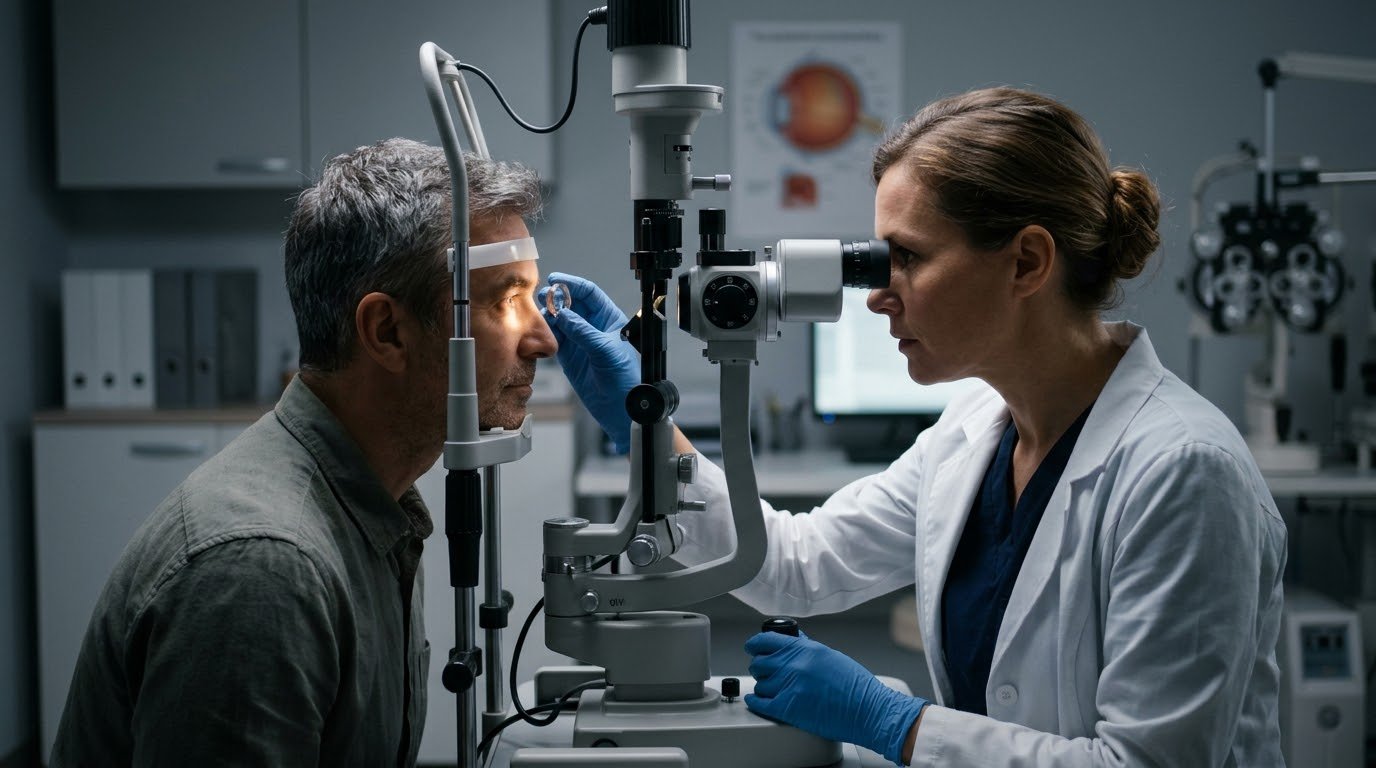
Gonioscopy CPT Code 92020: Reporting Scope and Core Rules
CPT 92020 and Its “Separate Procedure” Designation
CPT 92020 describes gonioscopy, an examination of the anterior chamber angle. Clinicians use this examination to assess findings relevant to glaucoma and other angle abnormalities. The gonioscopy cpt code includes a “separate procedure” designation. Therefore, coders must consider whether another reported service already includes that work.“Separate procedure” does not guarantee separate payment whenever the clinician performs gonioscopy. Equally, the designation does not automatically prohibit reporting alongside every office visit. Instead, examine the clinical circumstances, applicable coding instructions, and payer edits. Commercial insurers may apply different bundling policies from Medicare.Quick Billing Reference
| Billing element | Reporting consideration |
| Procedure code | 92020 |
| Service | Diagnostic gonioscopy |
| Documentation | Clinical indication, examination, findings, and management relevance |
| Units | Generally one unit for one or both eyes |
| Separate payment | Depends on circumstances, edits, and payer policy |
| Reimbursement | Varies by payer, setting, locality, and contract |
Medical Necessity and Diagnosis Selection
Clinical Reasons Supporting the Examination
Medical necessity begins with the clinician’s reason for examining the angle. Relevant circumstances may include glaucoma assessment, suspected angle narrowing, or evaluation of documented angle abnormalities. Repeat examinations also need a current clinical purpose. Therefore, explain why reassessment matters during that encounter.Avoid relying entirely on a historical diagnosis copied between visits. Instead, connect the examination with the patient’s present condition or management needs. The gonioscopy cpt code should represent a medically supported service. Routine scheduling alone does not establish that support.ICD-10-CM Selection Based on Documented Findings
Choose diagnosis codes from the authenticated clinical record. Include laterality and glaucoma stage whenever the selected diagnosis requires those details. For outpatient encounters, follow applicable rules for uncertain diagnoses. Never convert a suspected condition into a confirmed diagnosis simply to obtain payment.| Documented situation | Coding focus |
| Established glaucoma | Documented type, laterality, and applicable stage |
| Suspected angle abnormality | Supported condition, signs, or findings |
| Repeat examination | Current reason for reassessment |
| Unclear diagnosis | Clinician clarification before submission |
Documentation Supporting CPT 92020
Examination Details and Clinical Findings
Strong documentation explains the reason, performed work, and relevant results. A brief statement such as “gonioscopy done” provides limited clinical context. Instead, record meaningful findings and their relationship to patient management. This approach helps reviewers understand the service without guessing.Useful documentation elements include:- Clinical reason for testing.
- Eye or eyes examined.
- Relevant examination technique.
- Angle findings and abnormalities.
- Examination limitations.
- Interpretation and management implications.
- Provider authentication.
Gonioscopy Grading and Angle Findings
Gonioscopy grading communicates the clinician’s assessment of angle anatomy. When clinicians document a grading system, identify it clearly. Also, record relevant structures, findings, and limitations where appropriate. These details provide clinical context rather than additional billable units.A four-mirror gonioscopy lens does not automatically create another separately payable service. Likewise, different gonioscopy grades do not establish different CPT codes. Select the gonioscopy cpt code according to the service performed. Keep equipment terminology secondary to accurate clinical reporting.Physician Orders and Reporting Requirements
The American Academy of Ophthalmology’s billing guidance addresses orders and documentation for physician-performed gonioscopy. It explains that this physician-performed procedure does not require a separate physician order. Documentation should support necessity, performed work, and treatment-relevant findings. Check additional requirements when another payer’s policy applies. American Academy of OphthalmologyUnilateral and Bilateral Gonioscopy Billing
Units for One Eye Versus Both Eyes
Generally, report 92020 once whether the clinician examines one eye or both. Do not automatically increase units because the record documents bilateral findings. Instead, distinguish clinical laterality from the service’s billing structure. Confirm current payer instructions before finalizing unusual claims.The gonioscopy cpt code should not generate duplicate charges through automated laterality settings. For example, software may create separate right-eye and left-eye lines. Review those defaults before releasing the claim. AAO guidance describes reporting once for unilateral or bilateral testing. American Academy of OphthalmologyModifier 50 and RT/LT Considerations
Do not automatically append modifier 50 when both eyes undergo examination. Similarly, avoid splitting charges with RT and LT without applicable payer support. Verify current fee schedule indicators and submission instructions. Then reconcile those requirements with your practice management system.Accurate gonioscopy cpt code reporting depends on both units and modifiers. Documenting both eyes remains clinically valuable even when billing one unit. Therefore, preserve detailed findings while correcting inappropriate charge configurations. Documentation detail and claim quantity serve different purposes.Same-Day Eye Examinations, Testing, and Modifier Review
Gonioscopy With E/M or Ophthalmological Services
A same-day office examination does not automatically prevent separate gonioscopy reporting. Nevertheless, each billed service must satisfy applicable documentation and coding requirements. Review the specific examination code, diagnostic service, and payer rules. Avoid assuming every combination follows identical reporting instructions.The gonioscopy cpt code also requires review against current procedure-to-procedure edits. Consult the CMS NCCI Policy Manual for Medicare coding principles. Then examine the edit files effective on the service date. Practitioner and outpatient hospital edits require separate attention. www.cms.govModifier 25, Modifier 59, and X Modifiers
Modifier selection begins with the circumstances, rather than the denial message alone. Modifier 25 describes a qualifying, separately identifiable E/M service. When appropriate, append it to the E/M code. Do not place it on 92020.Modifier 59 and applicable X modifiers identify qualifying distinct procedural circumstances. However, their use depends on the specific edit and documented facts. Check whether an edit permits an override before considering these modifiers. Never append them solely to force payment.Other Ophthalmic Tests on the Same Date
Review additional imaging, visual field testing, and other diagnostic services individually. Different diagnoses alone do not establish that services qualify for separate reporting. Likewise, different equipment does not automatically establish distinct work. Each service needs appropriate clinical and coding support.CMS distinguishes coding edits from medical necessity review. Its NCCI guidance explains that diagnosis codes do not determine NCCI edits. Therefore, changing diagnoses cannot resolve every bundled-service issue. Identify the actual reason before changing a claim. CMSDiagnostic Gonioscopy Versus Goniotomy and Surgical Visualization
CPT 92020 Versus CPT 65820
Diagnostic gonioscopy and goniotomy represent different services. Gonioscopy examines the angle, while goniotomy involves surgical treatment. Consequently, similar terminology does not justify interchangeable code selection. Review the examination record or operative report before choosing either code.| Comparison | Gonioscopy | Goniotomy |
| Code | 92020 | 65820 |
| Purpose | Diagnostic examination | Surgical treatment |
| Primary record | Examination findings | Operative report |
| Main concern | Separate reportability | Correct surgical identification |
Gonioscopy Integral to Surgery
Surgeons may use gonioscopy to visualize structures during an operation. That visualization can form an integral component of the surgical service. Therefore, its performance does not automatically justify another diagnostic charge. Evaluate any separately claimed examination against the full circumstances.Review the operative report, service timing, and applicable instructions. Also, distinguish independent diagnostic work from visualization necessary to complete surgery. Do not assume a separate note alone establishes separate reportability. The clinical service must satisfy the underlying coding requirements.Medicare, Medicaid, and Commercial Payer Review
Coverage and Claim Requirements
Coverage review should identify the patient’s actual insurance product. Medicare Advantage instructions may differ from Medicare fee-for-service claim processes. Similarly, Medicaid requirements vary across states and managed care plans. Commercial insurers also maintain their own contracts and reimbursement policies.| Payer | Review before submission |
| Medicare fee-for-service | Fee schedule indicators, NCCI edits, applicable MAC policies |
| Medicare Advantage | Plan coverage and billing instructions |
| Medicaid | State and managed care requirements |
| Commercial insurance | Benefits, contracts, and payer edits |
Gonioscopy Reimbursement and Patient Responsibility
Factors Affecting the Allowed Amount
Reimbursement varies with locality, setting, payer, and contract terms. Therefore, one published dollar amount cannot represent every practice. Use the CMS Physician Fee Schedule search for applicable Medicare information. Select the correct year and relevant payment details. CMSThe gonioscopy cpt code can produce different allowances across insurance products. Facility and nonfacility payment circumstances may also affect comparisons. Consequently, record the source when establishing an expected allowance. Update that reference when fee schedules or contracts change.Allowed Amount Versus Actual Payment
Billed charges do not equal the insurer’s allowed amount. Furthermore, the allowed amount does not always equal the insurer’s payment. Deductibles, coinsurance, and other applicable adjustments can affect the final distribution. Review the remittance before identifying an underpayment.Explain patient responsibility using the adjudicated claim and applicable rules. Do not automatically transfer every denied balance to the patient. Instead, review contractual obligations and relevant beneficiary protections. Accurate explanations help prevent avoidable billing disputes.Common CPT 92020 Denials and Corrective Actions
A denied claim requires investigation before resubmission. Start with the adjustment reason and accompanying remark codes. Next, compare those messages with the original claim and documentation. This review identifies whether correction, additional records, or appeal makes sense.| Claim issue | Review focus | Appropriate response |
| Excess units | Submitted quantity | Correct unsupported duplication |
| Bundled service | Code pair and policy | Assess separate reporting support |
| Medical necessity | Indication and coverage criteria | Review existing clinical evidence |
| Modifier rejection | Modifier and payer requirements | Correct inaccurate reporting |
| Missing records | Requested documentation | Submit supporting records |
| Unexpected allowance | Contract or fee schedule | Reconcile payment calculations |
Practical Gonioscopy Billing Scenarios
Diagnostic Gonioscopy During a Glaucoma Follow-Up
A clinician reassesses angle findings during a documented glaucoma follow-up. The record explains the indication, results, and management implications. The biller reviews the office service and applicable same-day edits. Separate payment remains subject to the patient’s payer requirements.The gonioscopy cpt code represents the diagnostic examination in this example. It does not establish automatic payment for every associated service. Therefore, review each line independently before submission. Treat this scenario as illustrative rather than universal instructions.Both Eyes Examined During One Encounter
A clinician documents gonioscopy findings for both eyes during one visit. The billing system generates two procedure lines automatically. The reviewer identifies the duplicate configuration and checks payer instructions. Generally, one unit represents this examination.Gonioscopic Visualization During Glaucoma Surgery
A surgeon uses gonioscopy while completing an angle-based operation. The operative report describes visualization necessary for the surgical work. The coder reviews whether that work forms an integral component. A separate diagnostic charge requires independent support under applicable rules.Conclusion
Accurate gonioscopy cpt code reporting requires more than selecting 92020. Connect the examination with medical necessity, meaningful findings, and correct units. Then review same-day services, modifier requirements, and payer policies. Consistent claim review supports defensible billing and more efficient denial resolution.Frequently Asked Questions (FAQs)
Get clear answers about gonioscopy CPT code 92020, including billing rules, modifiers, documentation requirements, and common claim denials.
Use CPT 92020 to report diagnostic gonioscopy. Documentation should support the examination’s medical necessity, performed work, and relevant findings.
Separate reporting may apply when documentation and payer rules support both services. Review current coding edits and the insurer’s policy before submitting the claim.
Generally, report one unit of CPT 92020 whether examining one eye or both. Confirm payer instructions before adding laterality modifiers.
No modifier applies automatically to every gonioscopy claim. Select modifiers only when the documented circumstances and applicable coding rules support them.
Record the clinical indication, examined eyes, relevant findings, interpretation, and management implications. Include examination limitations and provider authentication.
Gonioscopy integral to surgery generally does not qualify for separate reporting. Independently performed diagnostic services require supporting documentation and review of applicable edits.