
What Is a Principal Diagnosis in Hospice?
Definition of Principal Diagnosis
The principal diagnosis identifies the condition most contributory to the patient’s terminal prognosis. CMS specifically applies this standard to hospice claims.Consequently, coders should identify the underlying terminal condition before selecting the principal diagnosis. The selected code should also agree with supporting clinical documentation.The diagnosis should support the patient’s hospice status and documented terminal condition. Medicare hospice eligibility requires a prognosis of six months or less.Therefore, accurate diagnosis selection supports both coding accuracy and clinical consistency.Principal Diagnosis vs. Secondary Diagnoses
The principal diagnosis differs from secondary diagnoses. Secondary diagnoses can describe additional conditions affecting the patient’s care.These conditions may include comorbidities, symptoms, complications, or other documented health conditions.For example, a patient may have cancer, weakness, diabetes, and weight loss. The underlying terminal cancer may serve as the principal diagnosis.Meanwhile, weakness or diabetes may qualify as additional diagnoses when documentation supports them.Importantly, an unacceptable principal diagnosis does not always mean an unusable diagnosis. The code may still have a legitimate secondary reporting purpose.Why Correct Principal Diagnosis Selection Matters
Correct sequencing helps reduce avoidable claim problems. CMS states that claims with unacceptable principal diagnoses can return for correction.Consequently, coding errors can increase administrative rework. They can also delay claim processing and create unnecessary billing complications.Accurate coding also keeps claims consistent with clinical documentation. This consistency strengthens the connection between the patient’s condition and terminal prognosis.Ultimately, proper sequencing supports accurate hospice billing and regulatory compliance.What Are Unacceptable Principal Diagnosis Codes in Hospice?
Understanding the Hospice Unacceptable Diagnosis List
The hospice unacceptable diagnosis list identifies diagnoses that cannot serve as principal diagnoses under applicable Medicare guidance.CMS explains that the Medicare Code Editor identifies unacceptable principal diagnosis codes. CMS also updates related files periodically.Therefore, coders should avoid relying on old online lists. Instead, they should verify current CMS resources and applicable ICD-10-CM guidance.The list can include codes affected by sequencing conventions. It can also include symptoms, ill-defined conditions, and certain Z codes.Additionally, some codes require an underlying condition to appear first. Coders must review those requirements before submitting claims.The current CMS guidance became effective for claims received on or after April 1, 2025.Why a Code May Be Unacceptable as Principal but Appropriate as Secondary
An unacceptable principal diagnosis does not automatically become prohibited from the entire claim.Instead, the restriction concerns principal diagnosis sequencing. A condition may still appear as an additional diagnosis when documentation supports it.For example, debility can describe a patient’s clinical decline. However, CMS does not permit debility as the principal hospice diagnosis.Similarly, adult failure to thrive may provide useful clinical information. However, it should not replace the underlying terminal condition.Therefore, coders should evaluate principal and secondary diagnoses separately.Hospice Principal Diagnosis Rules You Need to Know
Rule 1 — Select the Diagnosis Most Related to the Terminal Prognosis
The first step involves identifying the condition driving the terminal prognosis.Review the physician’s certification and supporting clinical documentation. Then determine which diagnosis best explains the patient’s terminal status.Avoid selecting a nonspecific condition when documentation establishes a definitive disease.CMS requires the principal diagnosis to represent the diagnosis most related to terminal prognosis.These hospice principal diagnosis rules help maintain consistency between clinical records and submitted claims.Rule 2 — Follow ICD-10-CM Official Coding Guidelines
Coders must follow applicable ICD-10-CM coding conventions. CMS specifically directs hospices to follow the Alphabetic Index and Tabular List.Review all relevant instructions before assigning the principal diagnosis.These instructions include:- Code first instructions
- Use additional code instructions
- Excludes notes
- Etiology and manifestation conventions
- Applicable sequencing rules
Rule 3 — Don’t Automatically Use the Most Obvious Symptom
Symptoms often appear prominently in hospice documentation. However, symptoms do not always represent the underlying terminal condition.Common examples include weakness, weight loss, poor appetite, and functional decline.These conditions can support the overall clinical picture. Nevertheless, they may not qualify as principal diagnoses when a definitive disease exists.Consequently, coders should investigate the underlying documented condition first.Rule 4 — Review Documentation Before Assigning the Principal Diagnosis
Documentation should guide diagnosis selection. Coders should review the hospice certification and clinical assessments.They should also examine the comprehensive assessment and relevant physician documentation.Clinical history and diagnostic findings can provide additional context. Furthermore, the plan of care should remain consistent with the selected diagnosis.This documentation review helps prevent unsupported principal diagnosis selections.Rule 5 — Check Sequencing Requirements
Some diagnoses cannot appear first because ICD-10-CM requires different sequencing.For example, certain manifestation codes require an underlying etiology first. CMS specifically highlights this principle in its hospice coding guidance.Therefore, coders must review sequencing instructions before finalizing the claim.Debility Hospice Diagnosis: Why It Can Cause Problems
What Is Debility?
Debility generally describes weakness, reduced strength, or general physical decline.However, debility does not identify a specific underlying terminal disease. Therefore, it can create problems when used as the principal diagnosis.The debility hospice diagnosis requires careful consideration within the overall clinical documentation.Can Debility Be the Principal Hospice Diagnosis?
No. CMS identifies debility as an unacceptable principal hospice diagnosis. Claims using it as principal can return for correction.CMS considers debility a nonspecific diagnosis. Therefore, coders should identify a more definitive terminal diagnosis when documentation supports one.This rule represents an important consideration for unacceptable principal diagnosis codes hospice.Can Debility Be Reported as a Secondary Diagnosis?
Debility can describe a patient’s clinical condition. However, coders should evaluate its role separately from the principal diagnosis.If documentation supports debility as an additional condition, the hospice may report it accordingly.Therefore, coders should not remove every mention of debility simply because it cannot serve as principal.Common Debility Coding Mistakes
Several mistakes occur during principal diagnosis selection.First, coders may select debility because the patient shows significant decline. Second, they may overlook a documented terminal disease.Additionally, coders may fail to review physician documentation. Finally, they may mistake a symptom description for the underlying disease.A structured review can prevent these errors.Adult Failure to Thrive Hospice: Principal Diagnosis Rules
What Is Adult Failure to Thrive?
Adult failure to thrive describes a pattern involving significant physical decline.It can involve weight loss, reduced nutritional intake, weakness, and functional deterioration.However, these findings may result from an underlying disease. Therefore, coders should investigate the documented cause before assigning the principal diagnosis.Can Adult Failure to Thrive Be the Principal Hospice Diagnosis?
No. CMS states that hospices may not report failure to thrive as the principal hospice diagnosis.The same principle applies when reviewing adult failure to thrive hospice coding.The coder should identify the underlying terminal condition when documentation supports one.This distinction helps prevent an unacceptable principal diagnosis from reaching the claim.Adult Failure to Thrive as a Secondary/Additional Diagnosis
Adult failure to thrive may still provide relevant clinical information.Therefore, coders should evaluate whether documentation supports reporting it as an additional diagnosis.The principal diagnosis should remain focused on the condition most related to terminal prognosis.Why Failure to Thrive Is Often Misused
Failure to thrive can appear prominently in hospice documentation. Patients may experience weight loss, poor intake, and functional decline.However, an underlying disease may explain these findings.For example, advanced disease may cause nutritional deterioration and reduced mobility.Therefore, coders should not automatically choose failure to thrive when a definitive terminal condition exists.Dementia and Other Diagnosis Codes That May Be Unacceptable as Principal
Why Certain Dementia Codes Create Sequencing Issues
Certain dementia diagnoses can create sequencing challenges.These challenges arise because ICD-10-CM may require an underlying disease to appear first.CMS specifically discusses dementia associated with Parkinson’s disease as an example.Therefore, coders should review the applicable etiology and manifestation instructions.Underlying Disease vs. Manifestation
Consider a patient with Parkinson’s disease and associated dementia.Parkinson’s disease represents the underlying condition. Dementia represents the manifestation associated with that disease.Consequently, sequencing should follow the applicable ICD-10-CM instructions.CMS explains that the underlying Parkinson’s disease code should sequence first. The associated dementia code follows as the manifestation.This example demonstrates why unacceptable principal diagnosis codes hospice require more than simple code selection.Unspecified Dementia and Principal Diagnosis Considerations
Unspecified dementia can also create sequencing concerns.CMS guidance states that hospices may not report unspecified dementia codes as principal hospice diagnoses.Therefore, coders should investigate whether an underlying condition exists.They should also review current ICD-10-CM instructions before selecting the principal diagnosis.Other Categories to Review on the Hospice Unacceptable Diagnosis List
Symptom, Sign, and Ill-Defined Condition Codes
Symptoms and signs can provide important clinical information. However, they should not replace a definitive diagnosis when one exists.ICD-10-CM guidance restricts certain Chapter 18 codes when a related definitive diagnosis has been established. CMS specifically references this principle for hospice claims.Therefore, coders should look beyond symptoms during diagnosis review.Z Codes
CMS states that hospice claims cannot use ICD-10-CM Z codes as principal diagnoses.Therefore, coders should carefully review any Z code proposed for principal sequencing.However, this restriction does not mean every Z code lacks clinical relevance.Coders should evaluate whether the code belongs elsewhere within the claim.Manifestation Codes
Manifestation codes require special sequencing attention.First, identify the underlying etiology. Next, review the manifestation code instructions.Then, apply the required sequencing order.This process helps prevent errors involving unacceptable principal diagnosis codes hospice.Codes Requiring Additional Sequencing
Some codes include specific sequencing instructions.A code-first instruction means another condition must appear first. A use-additional-code instruction requires another code to provide additional information.Therefore, coders should read the Tabular List carefully.How to Choose the Correct Hospice Principal Diagnosis
A consistent workflow can simplify principal diagnosis review.Step 1: Review the Patient’s Terminal Condition
Start with the documented terminal condition.Identify the disease driving the patient’s terminal prognosis. Then compare it against the proposed principal diagnosis.Step 2: Review Physician Certification
Review the physician’s certification and supporting records.Confirm that the diagnosis aligns with the documented terminal prognosis.The certification and claim should tell a consistent clinical story.Step 3: Identify Whether the Selected Code Is Definitive
Ask several questions before finalizing the code:- Is this a disease?
- Is this a symptom?
- Is this an unspecified condition?
- Does another documented disease explain the condition?
- Does the code require another condition first?
Step 4: Check ICD-10-CM Sequencing Instructions
Review the Tabular List and applicable coding guidelines.Check code-first instructions and use-additional-code instructions.Also review Excludes notes and manifestation conventions.Step 5: Check the Current CMS Unacceptable Principal Diagnosis Guidance
CMS updates its guidance and processing resources.Therefore, coders should use current CMS resources instead of outdated online lists.CMS’s 2025 update specifically revised the unacceptable principal diagnosis list.Step 6: Compare the Claim With the Medical Record
Review the claim against the supporting documentation.Check the assessment, certification, plan of care, and clinical records.Consistency helps identify coding discrepancies before submission.Step 7: Determine Secondary Diagnoses Separately
Do not eliminate clinically relevant conditions simply because they cannot serve as principal.Instead, evaluate each diagnosis independently.This approach supports complete and accurate claim reporting.Common Hospice Principal Diagnosis Coding Errors
Using Debility as the Principal Diagnosis
Debility remains a common sequencing concern.Coders should determine whether documentation identifies a more definitive terminal disease.CMS specifically identifies debility among unacceptable principal hospice diagnoses.Using Adult Failure to Thrive as the Principal Diagnosis
Adult failure to thrive can describe substantial decline.Nevertheless, it should not replace an established terminal condition.Coders should review the medical record for the underlying disease.Choosing a Symptom Instead of the Underlying Disease
Weight loss may occur because of advanced disease. Weakness may also result from disease progression.Likewise, functional decline may reflect an underlying terminal condition.Therefore, coders should investigate the cause rather than automatically selecting the symptom.Ignoring ICD-10-CM Sequencing Instructions
Sequencing instructions can significantly affect principal diagnosis selection.Ignoring these instructions can lead to incorrect claims.Therefore, coders should review the complete Tabular List before finalizing diagnosis sequencing.Using an Outdated Unacceptable Diagnosis List
Coding resources can become outdated quickly.CMS periodically updates its processing files and guidance.Therefore, coders should verify the current hospice unacceptable diagnosis list before claim submission.Failing to Match Coding With Documentation
The diagnosis should reflect the medical record.If the claim identifies one condition while documentation supports another, the discrepancy requires review.Strong documentation alignment can reduce coding and compliance concerns.Hospice Principal Diagnosis Coding Example Scenarios
Scenario 1 — Debility With an Established Terminal Disease
A patient has an established terminal disease and significant functional decline.The record also documents generalized weakness and debility.The coder should evaluate the terminal disease as the principal diagnosis.Debility may remain relevant as an additional diagnosis when documentation supports it.Therefore, debility should not replace the underlying terminal condition.Scenario 2 — Adult Failure to Thrive With an Underlying Disease
A patient experiences substantial weight loss and reduced oral intake.The medical record also documents an advanced terminal disease.The coder should evaluate the underlying disease for principal sequencing.Adult failure to thrive may provide additional clinical information when appropriately documented.However, it should not become the principal hospice diagnosis.Scenario 3 — Dementia With an Underlying Neurological Disease
A patient has Parkinson’s disease with associated dementia.The coder should review the applicable etiology and manifestation instructions.The underlying disease should sequence before the manifestation when required.CMS uses this situation as an example of proper sequencing.Scenario 4 — Symptom Without a Definitive Diagnosis
A patient presents with weakness and significant functional decline.The documentation does not establish a definitive underlying disease.The coder should review all available documentation before assigning the principal diagnosis.The coder should also apply current ICD-10-CM guidelines.This prevents assumptions based solely on symptoms.How Unacceptable Principal Diagnosis Codes Can Affect Hospice Claims
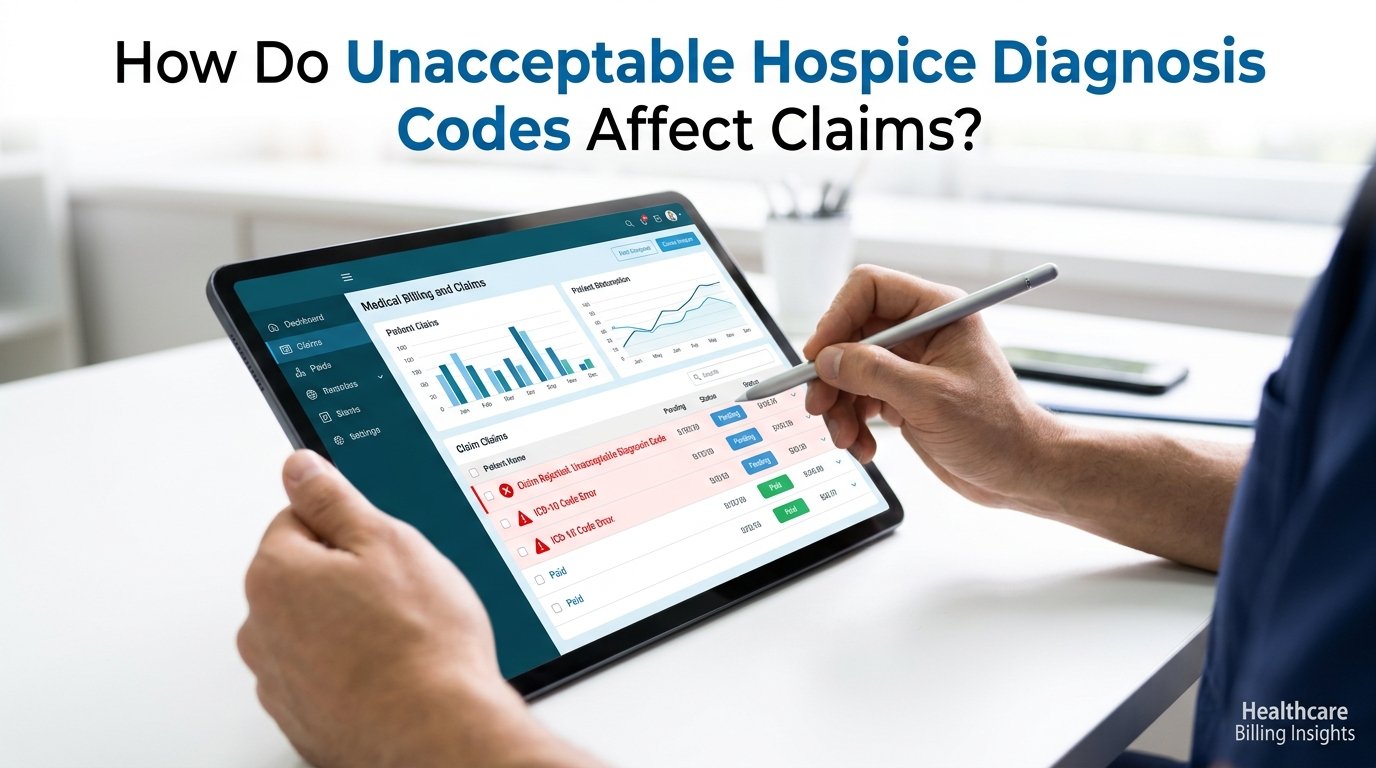
Claim Returned for Correction
CMS states that claims containing unacceptable principal diagnoses can return for correction.Therefore, coders should identify sequencing issues before claim submission.A pre-billing review can help catch these problems earlier.Payment and Processing Delays
Incorrect diagnosis sequencing can create additional administrative work.Returned claims require review, correction, and resubmission.Consequently, these errors can increase workload and potentially delay payment.Effective hospice billing services should therefore include careful diagnosis validation and claim review.Compliance and Documentation Risks
Incorrect principal diagnosis selection can create documentation concerns.It can also weaken the connection between the claim and terminal prognosis.Therefore, hospice teams should maintain accurate diagnosis selection, sequencing, and documentation.Best Practices for Hospice Coders and Billing Teams
Maintain Current ICD-10-CM References
Use the ICD-10-CM guidelines applicable to the service year.Review annual updates and applicable coding changes.Also verify relevant CMS guidance before submitting claims.Monitor CMS Updates
CMS provides updates through manuals, transmittals, and other official resources.CR 13882 updated hospice principal diagnosis guidance and the related unacceptable diagnosis list.Therefore, teams should monitor CMS changes throughout the year.Establish a Pre-Billing Diagnosis Review
Create a consistent review process before claim submission.The workflow should verify:- Terminal diagnosis
- Principal diagnosis
- ICD-10-CM sequencing
- Unacceptable principal diagnosis status
- Supporting documentation
Educate Coding and Billing Staff
Training should cover the hospice principal diagnosis rules that affect claim submission.Teams should also review debility, adult failure to thrive, dementia, symptoms, and Z codes.Additionally, staff should learn how to identify current CMS updates.Regular education helps teams manage changing coding requirements.Hospice Principal Diagnosis Coding Checklist
Use this checklist during pre-billing diagnosis review:- Is the principal diagnosis supported by documentation?
- Does it relate closely to the terminal prognosis?
- Does a definitive diagnosis exist?
- Is the selected code acceptable as principal?
- Have ICD-10-CM sequencing rules been reviewed?
- Have code-first instructions been satisfied?
- Have use-additional-code instructions been reviewed?
- Has debility been evaluated correctly?
- Has adult failure to thrive been evaluated correctly?
- Have dementia sequencing rules been reviewed?
- Has current CMS guidance been checked?
- Are secondary diagnoses reported separately when appropriate?
Key Takeaways About Unacceptable Principal Diagnosis Codes Hospice
Accurate principal diagnosis selection remains essential for hospice claim accuracy.The principal diagnosis should represent the condition most related to terminal prognosis.However, not every documented condition can serve as principal.Debility and adult failure to thrive cannot serve as principal hospice diagnoses under applicable CMS guidance.Certain dementia codes also require careful sequencing. Etiology and manifestation rules can determine which diagnosis comes first.Additionally, Z codes cannot serve as principal diagnoses on hospice claims under CMS guidance.Therefore, coders should always review current ICD-10-CM and CMS guidance.Most importantly, avoid relying on outdated code lists. CMS’s current processing guidance identifies unacceptable principal diagnoses through Medicare claims-processing mechanisms.Finally, maintain consistency between clinical documentation and submitted claims. This approach supports accurate coding, cleaner claims, and stronger compliance practices.Frequently Asked Questions (FAQs)
Get clear and concise answers about unacceptable hospice principal diagnosis codes, including debility, adult failure to thrive, dementia sequencing, CMS requirements, and common hospice coding errors.
Debility does not identify a specific underlying terminal condition. CMS does not allow debility as the principal hospice diagnosis. Therefore, coders should identify the documented condition driving the terminal prognosis.
Coders should review the documentation for the underlying terminal condition. Adult failure to thrive should not replace that condition as the principal diagnosis. However, documentation may support reporting it as an additional diagnosis.
A symptom should not replace a definitive documented disease. Coders should identify the condition responsible for the patient’s terminal prognosis. They must then apply the applicable ICD-10-CM sequencing guidelines.
Certain dementia conditions involve specific etiology and manifestation rules. The underlying disease may require sequencing before the dementia manifestation. Coders should therefore review the Tabular List before assigning the principal diagnosis.
Coders should review current CMS guidance whenever they perform hospice diagnosis reviews. CMS can update its claims-processing requirements and related diagnosis files. Using current resources helps prevent reliance on outdated coding information.
Coders should compare the diagnosis with the terminal prognosis and supporting documentation. They should also review ICD-10-CM sequencing instructions and current CMS guidance. Finally, they should confirm that the selected code qualifies as a principal diagnosis.