TL;DR
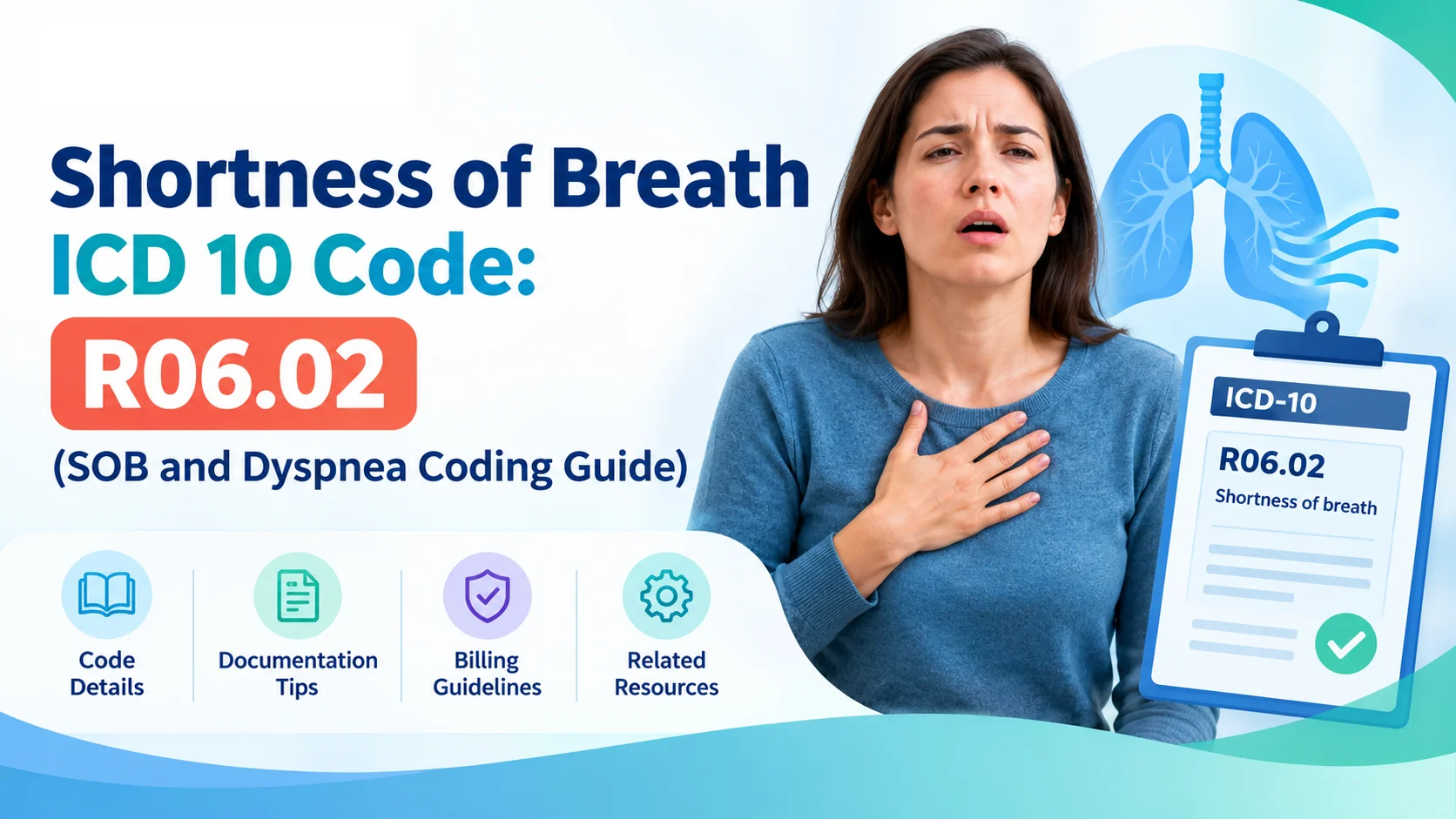
- The ICD-10 code for shortness of breath (SOB) is R06.02, and it is billable.
- R06.00 covers dyspnea, unspecified. Use it only when the note says “dyspnea” with no further detail.
- ICD-10-CM has no separate codes for acute or chronic dyspnea.
- Skip R06.02 once a confirmed diagnosis, such as CHF or COPD, explains the symptom.
- The FY2027 update made no changes to R06 codes.
Shortness of breath shows up in almost every care setting, yet it causes a surprising number of claim denials. Coders pick R06.00 when the note says SOB, report the symptom next to a confirmed diagnosis, or list it as primary on a home health claim. Each mistake delays payment. This guide fixes that problem. You will learn the correct shortness of breath ICD 10 code, when to use it, and when to leave it off.
What Is Shortness of Breath ICD 10 code?
The Shortness of Breath ICD 10 code is R06.02, which stands for shortness of breath. Providers write “SOB” as clinical shorthand, and coders assign R06.02 whenever the documentation uses that term. As a result, SOB, shortness of breath, and breathlessness all lead to the same code.
Here are the key facts about R06.02:
| Detail | R06.02 |
|---|---|
| Description | Shortness of breath |
| Billable | Yes |
| Chapter | 18, Symptoms and Signs (R00-R99) |
| Category | R06, Abnormalities of breathing |
| MS-DRG | 204, Respiratory signs and symptoms |
| In use since | October 1, 2015, with no changes through FY2027 |
In addition, category R06 carries an Excludes1 note. That means you never report R06.02 together with acute respiratory distress syndrome (J80), respiratory failure (J96.-), or respiratory arrest (R09.2). Newborn breathing problems also move to the P22 and P28 codes instead.
Dyspnea ICD-10 Codes: The Complete R06.0 List
The dyspnea ICD-10 codes sit under R06.0, and each one describes a different breathing problem. R06.0 itself is a parent code, so you cannot bill it. Instead, choose the specific code that matches the provider’s words.
| Code | Description | Use it when the note says |
|---|---|---|
| R06.00 | Dyspnea, unspecified | “Dyspnea” with no type or detail |
| R06.01 | Orthopnea | SOB when lying flat, relieved by sitting up |
| R06.02 | Shortness of breath | “SOB” or “shortness of breath” |
| R06.03 | Acute respiratory distress | Acute respiratory distress, not ARDS |
| R06.09 | Other forms of dyspnea | Dyspnea on exertion, air hunger, other specified types |
For example, a note that reads “patient needs three pillows to breathe at night” points to R06.01. On the other hand, “patient gets winded climbing one flight of stairs” points to R06.09. The wording in the chart always drives the code.
When you feel unsure, start with the ICD-10-CM Alphabetic Index under “Dyspnea.” The index sends asthmatic dyspnea to J45.909, newborn dyspnea to P28.89, and hyperventilation to R06.4. After that, confirm your choice in the Tabular List before you finalize the claim. This two-step habit prevents most dyspnea coding errors.
R06.00 vs. R06.02: Dyspnea vs. Shortness of Breath
Clinically, dyspnea and shortness of breath mean nearly the same thing. However, ICD-10-CM gives them separate codes, so the provider’s exact term decides which one you report. If the note says “SOB,” use R06.02. If it says “dyspnea” and nothing more, use R06.00.
Many coders default to R06.00 because it sounds broader. That habit creates mismatches during audits, because the code no longer reflects the documentation. Therefore, always code what the provider wrote, not what the symptom feels like.
Is There an Shortness of Breath ICD 10 Code, Unspecified?
No, ICD-10-CM does not include a “shortness of breath, unspecified” code. R06.02 already serves as the default code for SOB. When a provider documents SOB without any detail, R06.02 remains the right choice.
Three nearby codes often confuse coders, so keep them straight:
- R06.00 covers dyspnea, unspecified.
- R06.9 covers an unspecified abnormality of breathing, not dyspnea.
- R06.89 covers other specified breathing abnormalities, such as breath-holding.
Acute vs. Chronic Dyspnea ICD-10 Coding
ICD-10-CM does not offer separate codes for acute dyspnea or chronic dyspnea. Instead, you code the documented type of breathing problem, and when possible, the condition behind it. This approach keeps claims accurate for both sudden and long-term cases.
Acute Dyspnea
For new or sudden breathlessness, use R06.02 or R06.00 based on the provider’s wording. If the provider documents acute respiratory distress, report R06.03. However, never assign J80 unless the provider specifically diagnoses acute respiratory distress syndrome.
Chronic Dyspnea
Chronic dyspnea almost always has a known cause, such as COPD or heart failure. In those cases, code the underlying condition, like J44.9 or I50.9, rather than the symptom. Use an R06.0 code only when the provider has not yet established a cause.
Dyspnea on Exertion
Dyspnea on exertion (DOE) maps to R06.09, Other forms of dyspnea. Coders commonly misreport DOE as R06.02, so check the note carefully. Also, look for a stated cause, because exertional breathlessness in a known heart failure patient belongs under I50.-.
When NOT to Code R06.02
Symptom codes work well until a provider confirms the diagnosis. According to Section I.B.4 and I.B.5 of the ICD-10-CM Official Guidelines for Coding and Reporting, you should not report a sign or symptom that routinely comes with a confirmed condition. Consequently, once the provider names the cause, the definitive code replaces R06.02.
| Confirmed diagnosis | Code instead of R06.02 |
|---|---|
| Heart failure | I50.- |
| COPD | J44.- |
| Asthma | J45.- |
| Pneumonia | J18.- |
| Pulmonary embolism | I26.- |
| Post-COVID condition | U09.9 |
| Psychogenic dyspnea | F45.8 |
That said, you may still report R06.02 when the symptom does not usually come with the confirmed condition. For instance, SOB in a patient treated for a sprained ankle deserves its own code.
Outpatient vs. Inpatient Uncertain Diagnoses
Setting matters here. In outpatient care, Section IV of the guidelines tells you not to code “rule out,” “probable,” or “suspected” conditions. So, if the note says “SOB, rule out CHF,” you report R06.02. In inpatient care, however, you may code an uncertain diagnosis as if it were confirmed at discharge.
Common SOB Coding Myths
Several errors keep circulating online. First, R06.04 does not exist, since orthopnea is R06.01. Second, R06.02 does not mean “SOB on exertion.” Finally, R06.03 describes acute respiratory distress, not general breathlessness.
Coding Shortness of Breath by Care Setting
Each care setting applies its own rules to symptom codes. As a result, the same R06.02 can pass in the ER and fail on a home health claim. Here is how to handle each setting.
Emergency Department and Outpatient Visits
In the ER or clinic, R06.02 works as the first-listed code while the workup continues. Pair it with the services that support it, such as E/M codes 99213 to 99215, pulse oximetry (94760), a chest X-ray (71046), or spirometry (94010).
Home Health (PDGM)
Under PDGM, R06.02 does not qualify as an acceptable primary diagnosis, and Medicare returns claims that list it first. Instead, report the condition driving care, such as COPD or heart failure, as primary. Then, add R06.02 as a secondary code when it fits, and make sure it aligns with the OASIS dyspnea item, M1400. Our home health billing team checks this alignment on every claim.
Hospice
Hospices must report the condition most related to the terminal prognosis as the principal diagnosis. According to CMS MLN Matters MM13882, Medicare returns claims that list a Chapter 18 symptom code as principal when a related definitive diagnosis exists. Therefore, code end-stage COPD or heart failure first, and list R06.02 only as a secondary code. For a full breakdown, read our Hospice Billing Guide 2026.
Behavioral Health
Behavioral health providers often see breathlessness tied to anxiety. When a provider documents psychogenic or functional dyspnea, the ICD-10-CM index points to F45.8, not R06.02. Similarly, for SOB during a panic attack, code the anxiety disorder, such as F41.0, as the main diagnosis.
Documentation Checklist for SOB Claims
Strong documentation protects every R06.02 claim. Before you submit, confirm the note includes:
- Onset and duration of the symptom
- Triggers, such as rest, exertion, or lying flat
- Oxygen saturation and vital signs
- Related symptoms, such as cough, wheezing, or chest pain
- The working or confirmed diagnosis
Here is a strong example: “Patient reports SOB for 3 days, worse with exertion. SpO2 93% on room air. Rule out CHF; BNP and chest X-ray ordered.” This note clearly supports R06.02 in an outpatient setting.
Common R06.02 Denials and How to Fix Them
Most shortness of breath denials trace back to a handful of avoidable mistakes. Fortunately, each one has a simple fix.
| Denial | Common cause | How to fix it |
|---|---|---|
| CO-16 | Missing or incomplete information | Add onset, findings, and diagnosis to the note |
| CO-50 | Not medically necessary | Link R06.02 to services that support it |
| Excludes1 edit | R06.02 billed with J96.- or J80 | Drop R06.02 and keep the definitive code |
| Returned claim | Symptom listed first on home health or hospice claims | Move the definitive diagnosis to primary |
In addition, a pre-submission claim scrub catches most of these errors before the payer does. That step alone saves days of rework.
Get Your Respiratory Claims Paid the First Time
Shortness of breath coding looks simple, but small errors lead to costly denials. Use R06.02 for SOB, match dyspnea codes to the provider’s words, and follow the rules for each care setting. You can always check the latest code updates on the CMS ICD-10 page.
If respiratory claims keep coming back, Right On Time Billing can help. Our certified coders review claims before submission and fix problems at the source. Contact us today for a free coding audit.
Related Guides and Resources
- Medical Coding Services
- Home Health Billing Services
- Hospice Billing Services
- Hospice Billing Guide 2026: NOE, HOPE and Claims
- Behavioral Health Prior Authorization Guide 2026
- Revenue Cycle Management Services
- CPT Code for CBC: Complete Blood Count Billing Guide
Frequently Asked Questions
What is the shortness of breath ICD 10 code?
The ICD-10 code for shortness of breath is R06.02. It is a billable code in category R06, Abnormalities of breathing. Coders also use it when providers write the abbreviation SOB.
Is R06.02 a billable code?
Yes, R06.02 is a billable and specific ICD-10-CM code. You can use it on claims for FY2027, since the October 1, 2026 update made no changes to it.
What is the difference between R06.00 and R06.02?
R06.00 covers dyspnea, unspecified, while R06.02 covers shortness of breath. The provider’s exact wording decides which code you use. “SOB” leads to R06.02, and plain “dyspnea” leads to R06.00.
What is the ICD-10 code for shortness of breath on exertion?
Most coders report dyspnea on exertion with R06.09, Other forms of dyspnea. Always review the full note first, because a confirmed cause, such as heart failure, takes priority.
Is there an ICD-10 code for chronic dyspnea?
No, ICD-10-CM has no specific chronic dyspnea code. Instead, code the underlying chronic condition, such as COPD or heart failure. Use R06.0 codes only when the cause remains unknown.
Can R06.02 be a primary diagnosis?
Yes, in outpatient and ER settings when no definitive diagnosis exists. However, home health and hospice claims should not list R06.02 first, because Medicare returns those claims.